
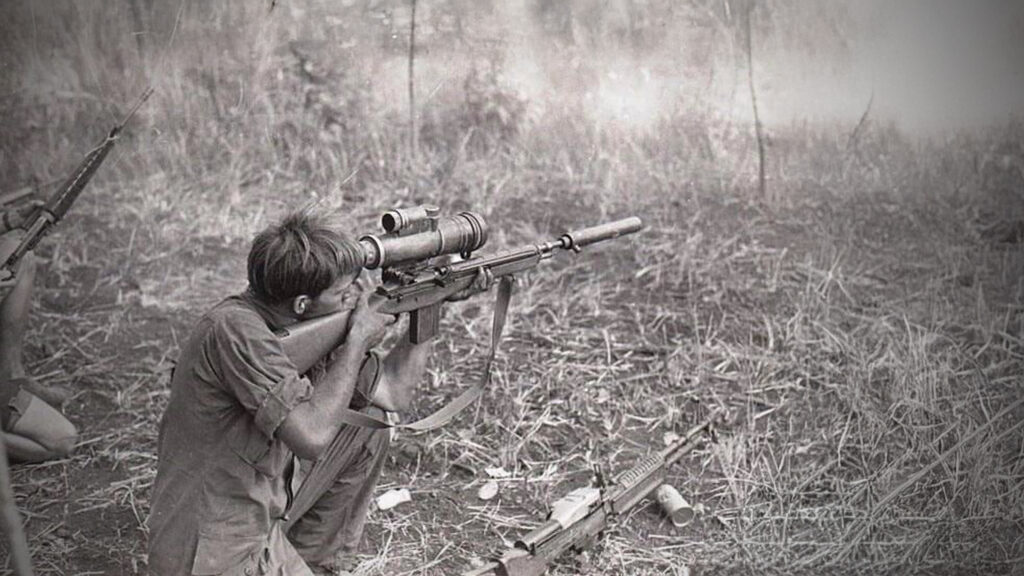
In the shadowy annals of American marksmanship, few rifles embody precision engineering and battlefield legend quite like the M21 Sniper Rifle. Born in the turbulent crucible of the Vietnam War, the M21 emerged as a semi-automatic evolution of the iconic M14 platform, chambered in 7.62x51mm NATO. Springfield Armory artisans hand-selected match-grade barrels and married them to the National Match M14 design, topped with the revolutionary ART (Adjustable Ranging Telescope) scope—essentially an early red dot precursor with adjustable reticles for rapid target acquisition in dense jungle warfare. Fielded by elite Marine and Army snipers from 1969 onward, it racked up confirmed kills that reshaped infantry tactics, proving a semi-auto sniper could outpace bolt-actions in follow-up shots while delivering sub-MOA accuracy at 600 yards. By the 1980s, it bowed to the bolt-action M24, but not before etching its name in lore alongside heroes like Gunnery Sergeant Carlos Hathcock.
What elevates the M21 beyond mere hardware is its unyielding testament to American ingenuity under fire—a civilian-derived battle rifle thrust into the sniper’s role, foreshadowing today’s precision semi-autos like the AR-10 derivatives dominating competitions and hunts. For the 2A community, it’s a rallying cry: this wasn’t some exotic import or government-only unicorn; it stemmed directly from the M14, itself rooted in the civilian Garand lineage, underscoring how our Second Amendment heritage fuels national defense. Critics decry assault weapons, yet the M21’s legacy mocks them—its semi-auto action saved lives without full-auto excess, and modern clones like the Springfield M1A NM prove these platforms thrive in responsible hands, from precision rifle series to varmint eradication.
Today, as ATF bureaucrats eye every barrel length and optic mount, the M21 whispers a defiant truth to gun owners: innovation born of freedom doesn’t kneel to regulation. Enthusiasts can still build near-replicas via M1A receivers and mil-spec parts, keeping the spirit alive at the range. In an era of endless modern sporting rifle debates, reclaiming the M21’s story reminds us that 2A isn’t about nostalgia—it’s about preserving the tools that win wars and safeguard liberty. Grab your clone, zero that scope, and honor the ghosts of ‘Nam; the implications are clear: suppress our rifles, and you suppress our resolve.


