
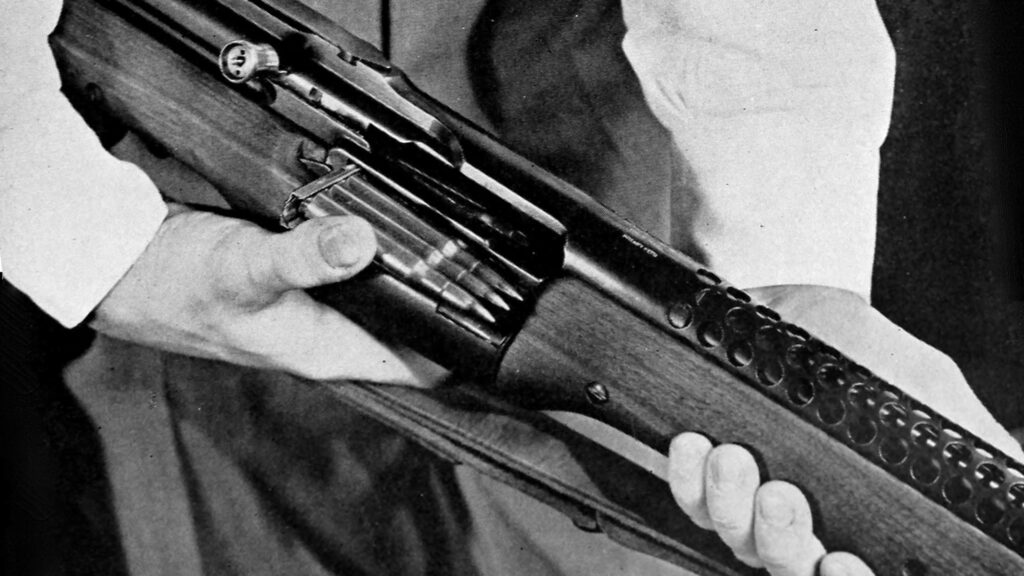
In the annals of American military history, few rivalries spark as much heated debate among firearms enthusiasts as the M1 Garand versus the M1941 Johnson Rifle. Tom Laemlien’s latest piece dives deep into this showdown, pitting the iconic semi-automatic workhorse of World War II against the innovative but short-lived Johnson—a rifle that promised revolutionary performance but faded into obscurity. The Garand, with its reliable gas-operated system and that unmistakable ping of an empty clip, became synonymous with U.S. infantry dominance, racking up over 5 million units produced and earning General Patton’s hyperbolic praise as the greatest battle implement ever devised. Laemlein masterfully contrasts this with the Johnson’s unique recoil-operated design, which allowed for faster barrel removal and superior accuracy in skilled hands, boasting a cyclic rate that could outpace the Garand in bursts while stripping from 5-round stripper clips with mechanical grace.
But let’s peel back the layers: why did the Garand win the day? It wasn’t just superior engineering—though John Garand’s piston-driven reliability shone in mud, sand, and freezing foxholes— but sheer industrial might and bureaucratic inertia. The Johnson, prototyped by a Marine-turned-inventor, impressed in early trials with its lighter weight (8.75 lbs vs. Garand’s 9.5) and pinpoint precision up to 600 yards, yet production hurdles doomed it to niche use by Dutch and Norwegian forces. Laemlein’s analysis highlights a pivotal truth: innovation alone doesn’t conquer; scalability does. Imagine if the Johnson had scaled—would it have rewritten Pacific Theater battles? For 2A advocates, this tale underscores the Garand’s enduring legacy as a symbol of American ingenuity, enshrined in CMP sales that keep these battle-proven rifles in civilian hands, fostering marksmanship and historical appreciation.
The implications for today’s Second Amendment community are profound. In an era of endless AR-15 debates, the Garand-Johnson saga reminds us that semi-auto superiority isn’t about raw specs but proven reliability under duress—a blueprint for defending modern platforms against regulatory overreach. Collectors snapping up mint-condition Johnsons (when they surface) at auction premiums teach us to champion underdogs, preserving rifle diversity against homogenization. As Laemlein concludes, both rifles embody the relentless pursuit of ballistic excellence; for pro-2A warriors, they’re not relics but rallying cries for the right to bear arms that have shaped freedom’s frontlines. Dive into the full story—it’s a masterclass in why history arms us for the fights ahead.


