
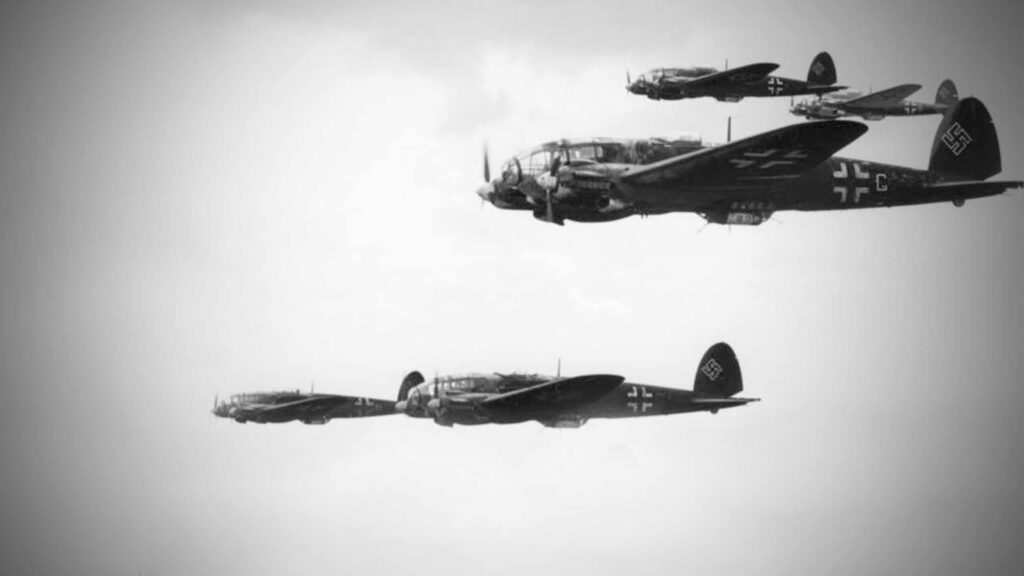
The Heinkel He 111 was Nazi Germany’s airborne Swiss Army knife, a bomber that bombed, a transport that hauled paratroopers, even a makeshift fighter in the Luftwaffe’s desperate final days. Designed in the early 1930s under the guise of a civil airliner to skirt Versailles Treaty restrictions, it first screamed into combat during the Spanish Civil War, where it shredded Republican targets and proved Luftwaffe tactics before the world. By Blitzkrieg’s thunder across Poland and France, the He 111’s sleek lines and twin engines powered dive-bombing runs that paved the way for panzers, but its real genius lay in adaptability—converted for torpedoes against Allied shipping, reconnaissance over the Atlantic, and even towing gliders for Hitler’s airborne follies like Crete. Will Dabbs nails it in his history piece: this bird did it all, from flattening London in the Blitz to schlepping supplies on the Eastern Front, until swarms of Spitfires and Mustangs turned it into flaming scrap by 1945.
What elevates the He 111 from mere warbird to 2A parable is its embodiment of versatile, multi-role capability—the same ethos that makes the AR-15 platform America’s modern jack-of-all-trades. Just as Heinkel engineers jury-rigged their bomber for any mission without starting from scratch, pro-2A folks mod their semi-auto rifles with uppers for plinking, hunting, or home defense, all while bureaucrats whine about assault weapons. The parallels scream: governments fear adaptable tools in citizen hands because they defy narrow categorization. Post-WWII, Allies scrapped the He 111’s designs to prevent resurgence, much like gun-grabbers today push red flag laws and mag bans to neuter modular firearms. Yet history whispers the truth—the He 111’s downfall wasn’t design flaws but overwhelming enemy firepower and production mismatches, a reminder that a well-armed populace, like the RAF or armed Yanks, tips scales against tyrants.
For the 2A community, the He 111’s legacy is a rallying cry: champion versatility. In an era of ATF reclassifications and state-level patchwork bans, stockpile parts, train across disciplines, and vote like your next mag dump depends on it—because when jack-of-all-trades tools face jackbooted overreach, the adaptable win. Dabbs’ tale isn’t just aviation porn; it’s a blueprint for why the right to keep and bear arms means keeping options open, from range day to whatever SHTF throws next. Fly the flag high, patriots.


