
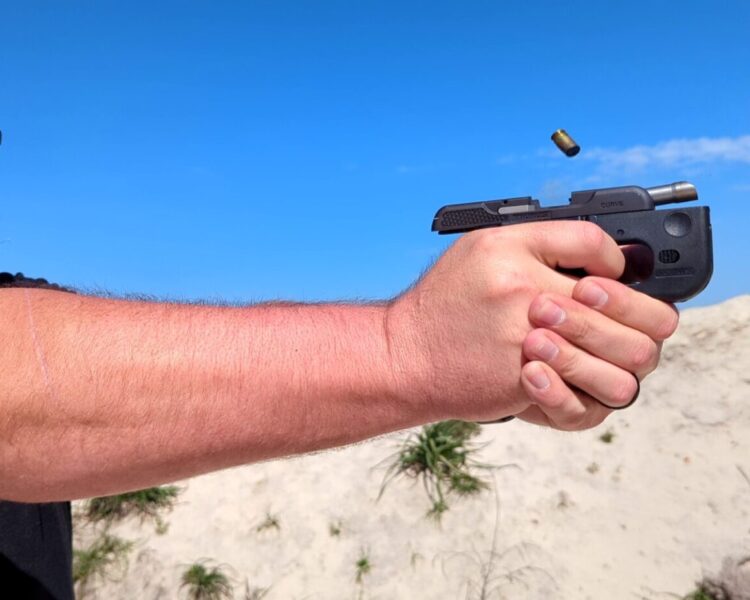
Recoil isn’t just that satisfying kick you feel after squeezing the trigger—it’s Newton’s third law in action, where every bullet blasting forward at supersonic speeds imparts an equal and opposite force backward into your gun and your shoulder. Picture this: a 9mm round might generate 4-6 ft-lbs of recoil energy, but scale up to a .308 Winchester in a semi-auto rifle, and you’re talking 15-20 ft-lbs or more, flipping the muzzle skyward like a rogue bottle rocket. The jump we all dread stems from the rapid acceleration of the projectile and expanding gases, compounded by the gun’s weight distribution, barrel length, and even your grip. Lighter guns amplify felt recoil because there’s less mass to absorb the impulse (momentum transfer), while heavier frames—like a steel 1911 versus an alloy striker-fired pistol—spread it out, turning a shoulder-pounder into a manageable push. For the 2A community, mastering this physics isn’t optional; it’s the difference between instinctive follow-up shots in a defensive scenario and fumbling under stress.
Reducing recoil flips the script from enduring physics to outsmarting it, and here’s where technique meets tactical upgrades. Start with the basics: a forward-weighted stance, high-grab thumbs forward grip, and flinching-free trigger reset shave off perceived jump by aligning your body as a recoil vector. Muzzle devices are game-changers—brakes like the SureFire ProComp redirect gases sideways, cutting vertical flip by 50% or more, while compensators on competition rigs (think PCCs in USPSA) tame even .45 ACP beasts. Swap to low-recoil ammo (e.g., 115gr 9mm vs. 147gr subsonics) or add a tungsten guide rod and recoil buffer in AR platforms, and you’re engineering compliance without sacrificing velocity. Implications for gun owners? In an era of red-flag laws and ammo taxes, optimizing your carry gun for minimal recoil means faster, more accurate hits—empowering new shooters (especially women and youth) to embrace 2A rights without intimidation, while preppers stock tuned setups for when SHTF demands reliability over raw power.
Ultimately, understanding recoil demystifies the anti-gun narrative that paints firearms as uncontrollable monsters. It’s pure science: momentum conservation dictates that a well-built, properly managed gun rewards skill with precision, not punishment. For the pro-2A crowd, this knowledge arms us against FUD—fear, uncertainty, doubt—pushed by those who’d disarm us. Dive into recoil mitigation, train hard, and turn every range session into a physics lesson that keeps the Second Amendment alive, one controlled shot at a time.


