
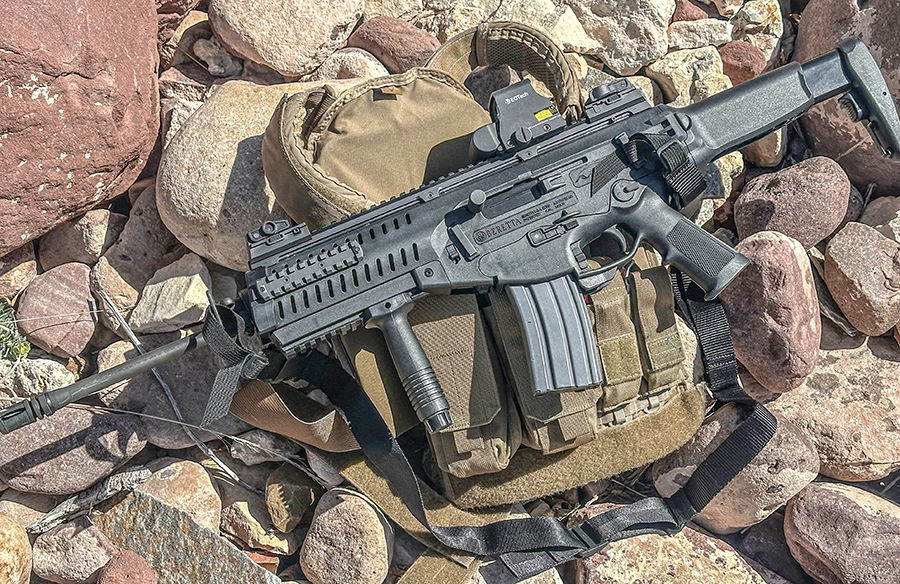
If I could predict the tastes of the American gun buyer, I’d be making money selling guns rather than writing about them. Hence the reason I’m still here typing away. But let’s talk about the Beretta ARX 100—a rifle that embodies everything Italian engineering brilliance should deliver, yet it fizzled in the U.S. market like a Ferrari at a monster truck rally. Introduced around 2013 as Beretta’s bold entry into the AR battle space, the ARX 100 promised modularity on steroids: a true ambidextrous design with swappable barrels, pistol grips, and stocks in a single platform, all without tools. Chambered in 5.56 NATO or .300 Blackout, it featured a cold-hammer-forged barrel, a slick gas-piston system for reliability in dirty conditions, and controls that flipped for lefties without breaking a sweat. On paper, it was a tactical dream—lighter than many ARs at 6.6 pounds unloaded, with a low bore axis for flatter shooting and Beretta’s legendary durability. Shooters who got their hands on one raved about its buttery smooth operation and how it outran direct impingement ARs in suppressed setups, making it a suppressor host par excellence.
So why didn’t it conquer America? Market timing and inertia played huge roles. The AR-15 ecosystem was already a Mil-Spec monopoly by the early 2010s, with parts compatibility reigning supreme—why gamble on a proprietary Italian import when you could build a Frankenstein AR from Anderson and PSA scraps for half the price? Beretta priced the ARX 100 around $1,800-$2,200, a premium tag that screamed boutique in a sea of $600 budget builds, and import delays plus limited dealer support meant it was ghosts in most gun shops. Add the 2013 panic-buying frenzy post-Sandy Hook, where buyers flocked to familiar black rifles, and Beretta’s focus on military contracts (it’s served Italian special forces) diverted promo energy from civilian hype. Clever analysis here: the ARX exposed a dirty truth about 2A tastes—we crave familiarity over innovation. It’s not that the ARX lacked merits; suppressed full-auto demos from Beretta’s YouTube archives still drop jaws. But American shooters are tribal; we mod what we know, and the ARX’s non-Mil-Spec furniture meant relearning your platform.
For the 2A community, the ARX 100’s flop is a cautionary tale with silver linings. It underscores how entrenched the AR hegemony is—good for standardization, bad for pushing boundaries—but also spotlights opportunities in the used market. These days, you can snag a lightly used ARX for $1,000-$1,400, turning a market reject into a collector’s gem or SHTF unicorn. Implications? It challenges us to rethink best beyond memes: if you’re tired of DI fouling or want true ambi without aftermarket hacks, hunt one down. Beretta’s pivot to the A400 shotgun empire shows they’re not quitting firearms, but this rifle reminds us innovation thrives when manufacturers court the everyman builder, not just elites. In a post-brace-ban world craving reliable, configurable rigs, the ARX 100 deserves a revival—grab one, run it dirty, and join the cult before prices rebound. Who’s with me?


