
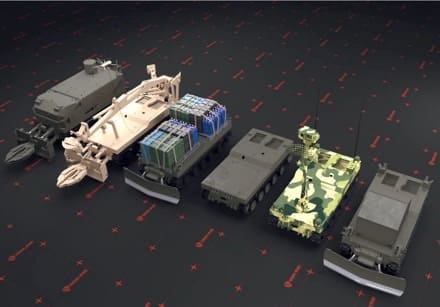
Rheinmetall, the German defense powerhouse already making waves with its cutting-edge artillery and armored vehicles, just inked a deal to snag a majority stake in Croatia’s DOK-ING, a Zagreb-based specialist in uncrewed ground systems. This isn’t some sleepy merger—it’s a strategic power play in the booming world of autonomous robotics, where DOK-ING’s battle-tested UGVs like the MV-4 and MVR-12 have proven themselves in explosive ordnance disposal, reconnaissance, and logistics under fire. Think heavily armed, remote-controlled beasts that can navigate minefields or deliver payloads without risking a single soldier. With conflicts from Ukraine to the Middle East showcasing the dominance of drones and bots, Rheinmetall is betting big on scaling these Croatian innovations into a full-spectrum autonomous arsenal.
For the 2A community, this acquisition ripples far beyond European battlefields, spotlighting the civilian-side potential of rugged UGVs that could democratize advanced tech. DOK-ING’s platforms aren’t just military-grade; they’ve got modular designs ripe for adaptation into private security bots, ranch patrols, or even hunting aids—envision a remote scout vehicle hauling gear across rough terrain or monitoring perimeters with thermal cams. As governments pour billions into uncrewed systems (Rheinmetall’s own order backlog hit €45 billion last year), this move pressures U.S. firms like Teledyne FLIR or Ghost Robotics to innovate faster, potentially trickling affordable, dual-use tech to American makers and hobbyists. It’s a reminder that Second Amendment rights extend to the tools of self-reliance: when autonomous systems become as commonplace as AR-15s, expect a surge in pro-2A advocacy for unregulated civilian access to non-lethal UGVs, framing them as force multipliers against urban threats or natural disasters.
The implications? Rheinmetall’s foothold in uncrewed ground tech accelerates a global arms race where software-defined warfare outpaces traditional firepower, but it also opens doors for 2A entrepreneurs. Picture open-source UGV kits emerging from this ecosystem, much like how AR parts exploded post-94 AWB. Pro-2A voices should watch closely—lobby for export controls that don’t stifle civilian innovation, and push narratives that armed autonomy belongs in responsible hands, not just state monopolies. This deal isn’t just corporate chess; it’s the future of decentralized defense knocking on America’s door.


