
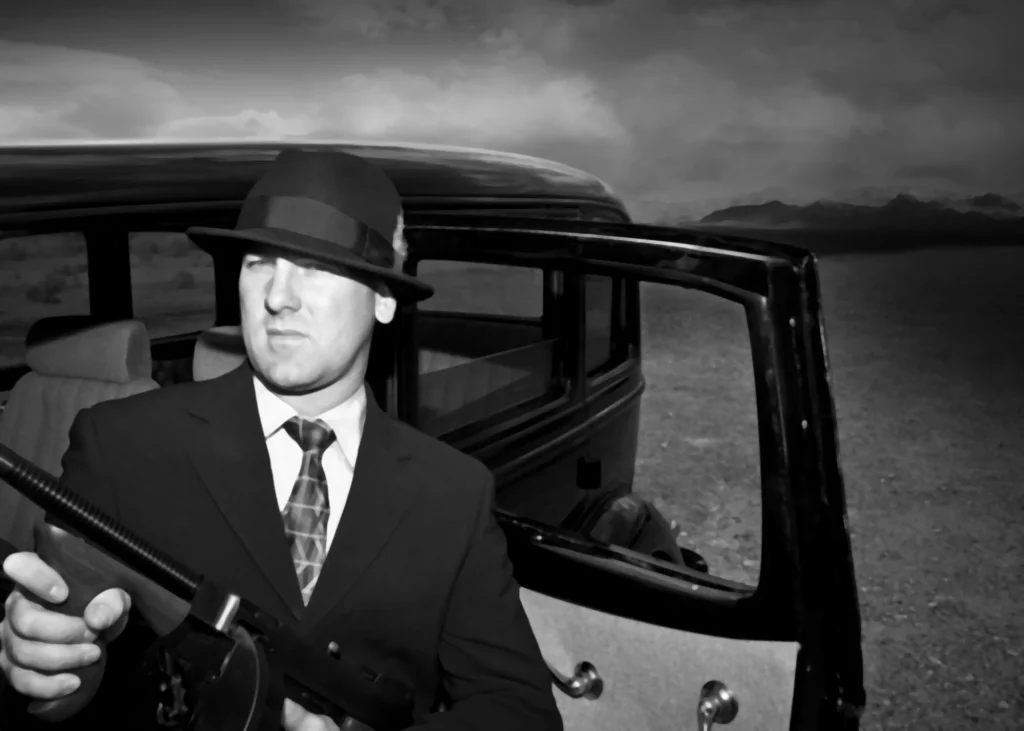
On February 14, 1929, Chicago’s snowy streets ran red with the blood of seven men gunned down in a Lincoln Park garage—a meticulously planned hit that shocked the nation and cemented the Saint Valentine’s Day Massacre as the brutal pinnacle of Prohibition-era gang warfare. Al Capone’s Chicago Outfit, locked in a turf war with George Bugs Moran’s North Side Gang, orchestrated the ambush using two impersonators dressed as police detectives to lure the victims outside. Armed with two Thompson submachine guns (the infamous Tommy guns), shotguns, and pistols, the killers unleashed a hail of over 100 rounds in under two minutes, leaving bodies riddled with bullets in a scene straight out of a gangster flick. Moran escaped by sheer luck, arriving just late enough to watch from across the street as his crew was slaughtered. This wasn’t random violence; it was a calculated message in the booze-soaked underworld where Capone’s empire raked in $100 million annually from illegal liquor, all while corrupt cops and politicians looked the other way.
Digging deeper, the massacre exposes the lethal folly of gun control fantasies in a lawless vacuum. Chicago in the 1920s already had stringent firearms restrictions under the 1923 Sullivan Act—requiring permits for handguns and banning machine guns for civilians—yet Capone’s thugs wielded military-grade Thompsons smuggled from Colt’s factory, unmodified and fully automatic. Law-abiding citizens were disarmed, while bootleggers armed to the teeth turned the city into a warzone, with over 500 gang-related murders that decade. The event fueled national hysteria, paving the way for the National Firearms Act of 1934, which taxed and registered machine guns, rifles, and silencers—America’s first major federal gun control law. Critics hailed it as a fix for gangster guns, but it did nothing to stem Capone’s rise; he was nabbed on tax evasion, not firearms charges. Fast-forward to today: Chicago’s modern handgun bans and assault weapon restrictions echo this failed playbook, correlating with sky-high murder rates while criminals ignore the rules.
For the 2A community, the Bloody Valentine is a stark warning etched in history’s ledger: disarmament empowers the violent elite, not the people. When governments can’t or won’t enforce laws against murderers, the right to keep and bear arms isn’t a luxury—it’s survival insurance against the next Capone. Skillset’s dive into this saga reminds us that the Second Amendment thrives not despite bloodshed, but to prevent it from overwhelming the innocent. In an era of rising urban decay and emboldened cartels, let’s honor the lesson: armed citizens deter massacres far better than bureaucratic registries ever could.


