
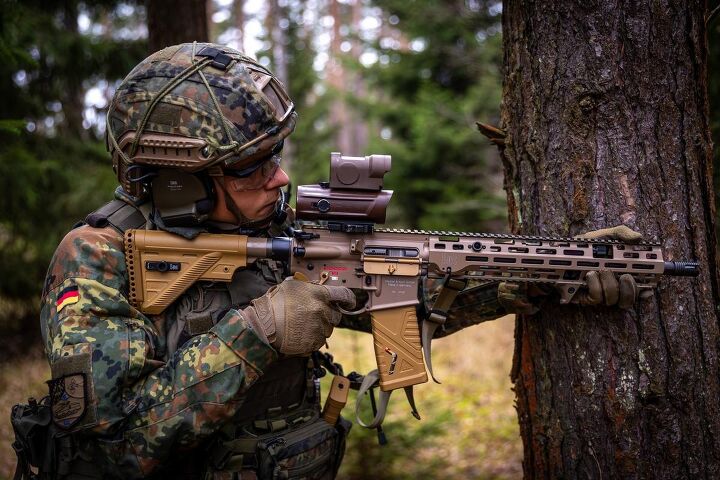
Panzergrenadier Battalion 122 in Oberviechtach just took delivery of the Bundeswehr’s first batch of G95 rifles, a milestone in Germany’s shift from the aging G36 to this beefed-up HK416 variant. Unlike the polymer-heavy G36 that suffered reliability issues in hot climates and barrel droop over time, the G95 doubles down on a metal chassis for superior durability, stability, and precision—think cold-hammer-forged barrels, ambidextrous controls, and that classic AR-15 ergonomics dialed up for NATO standards. It’s not just a rifle; it’s a pragmatic evolution, proving that even Europe’s strict gun-control regimes can’t ignore the AR platform’s unbeatable modularity and battle-proven track record when lives are on the line.
For the 2A community, this is catnip: the G95 validates everything we’ve championed about AR-15 derivatives. Germany’s Bundeswehr chose a gas-piston HK416 clone over pricier alternatives like the SCAR-L or exotic bullpups, echoing how civilian ARs dominate U.S. markets for their aftermarket ecosystem and user-swappability. Imagine a side-by-side with Sweden’s Sako AK 24—a modernized AK with adjustable gas and rails that nods to Kalashnikov resilience but lacks the AR’s precision optics marriage. Or contrast it with the U.S. Army’s XM7 (read: SIG Spear), which bets on 6.8x51mm for overmatch while the G95 sticks to battle-tested 5.56. The implication? Governments worldwide are converging on AR architectures because they work, underscoring why American civilians demand these platforms unhindered—durability isn’t political, it’s empirical.
This rollout signals broader NATO realignments amid Ukraine’s lessons: lighter, more accurate rifles with suppressors and optics win peer conflicts. For 2A advocates, it’s ammunition against assault weapon bans— if elite militaries like Germany’s prioritize AR ergonomics and metal robustness, why demonize the same tech in civilian hands? Stock up on your HK clones while you can; history favors the adaptable.


