
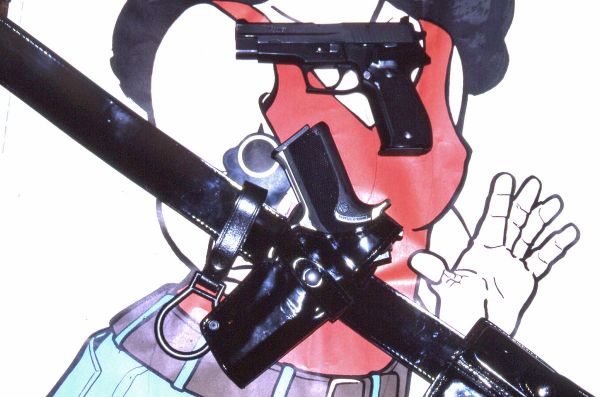
As far back as the late 1980s-early 1990s, the reliable police autoloader became ascendant. Above, the SIG P226 and S&W M4506 represent the 9mm vs. .45 Auto positions. Sometimes, a glance back at history helps us better understand where we are today. But let’s rewind even further to 1973, when the International Association of Chiefs of Police (IACP) conducted a landmark handgun search that shook the foundations of law enforcement armament—and by extension, the civilian firearms market. This wasn’t some casual poll; it was a rigorous evaluation of over 100 handgun models submitted by manufacturers, tested for reliability, accuracy, and durability under real-world abuse. The winners? A mix of wheelguns like the S&W Model 19 and Colt Python, alongside emerging semi-autos such as the S&W Model 59 and early SIGs. What stands out is how this search crystallized the 9mm vs. .45 debate decades before it dominated headlines, with testers praising the P226’s predecessor vibes for capacity and controllability against the .45’s legendary stopping power.
Fast-forward to the P226 and M4506 era of the ’80s-’90s, and you see evolution in action: police departments ditched revolvers en masse for high-capacity autoloaders, driven by FBI Miami shootout lessons and the 10mm’s brief swagger before settling on 9mm. The SIG P226, with its impeccable DA/SA trigger and overbuilt frame, became the gold standard for elite units (think Navy SEALs adopting the P226 as the MK25), while S&W’s M4506 brought .45 ACP thunder in a double-stack package that civilians could only dream of owning without NFA headaches. This shift wasn’t just tactical; it flooded the civilian market with battle-proven designs, proving that what works for cops trickles down to us 2A folks. Capacities jumped from 6-8 rounds to 15+, forcing ammo makers to innovate and prices to plummet—hello, affordable defensive carry.
For the 2A community, the 1973 search is a pro-freedom time capsule: it validated American ingenuity against imports, spurred innovation that benefits everyday carriers today, and reminds us that government adoption often lags private-sector brilliance. Implications? In a post-Bruen world, these classics underscore why assault weapon bans miss the mark—handguns evolved through testing, not tyranny. Grab a P226 clone or M4506-inspired 1911, hit the range, and channel that ’73 spirit. History isn’t just nostalgia; it’s ammo for the fight ahead.


