
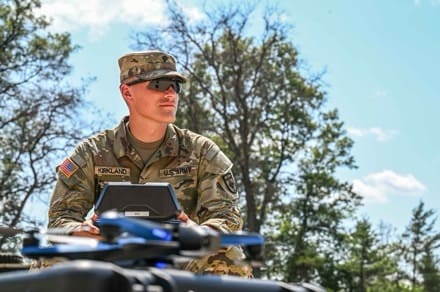
Michigan’s National All-Domain Warfighting Center (NADWC) just scored a major upgrade, earning designation from the U.S. Department of Defense (DoD)—not War, as some hasty reports might claim—as a National Range for Deep Uncrewed Aerial Systems (UAS) training. This Lansing-based hub, already a powerhouse for multi-domain military exercises, now becomes ground zero for pushing the envelope on long-range drone operations, from surveillance to precision strikes. Picture squadrons of advanced UAVs slicing through Michigan skies, honing tactics that blend air, land, sea, and cyber warfare. It’s a testament to the state’s growing role in next-gen defense tech, backed by federal bucks and local innovation, signaling America’s pivot toward unmanned dominance in an era of peer-level threats like China’s drone swarms.
For the 2A community, this isn’t just another DoD press release—it’s a flashing neon sign of how military tech trickles down to civilian hands, much like AR-15 platforms evolved from black rifle prototypes. Deep UAS training at NADWC means accelerated R&D in autonomous flight, AI targeting, and counter-drone countermeasures, tech that’s already spawning civilian analogs: think armed security drones for ranchers patrolling vast properties or personal UAVs with thermal optics for hunters tracking game from afar. We’ve seen it before—night vision from spec-ops gear became affordable for deer stands, suppressors refined from mil-spec silenced weapons now protect hearing on the range. As feds pour resources into this, expect spillover: cheaper, more capable consumer drones with 2A-friendly add-ons like modular mounts for optics or even non-lethal payloads. But here’s the rub—Uncle Sam designating national ranges amps up airspace control debates, potentially squeezing hobbyist flyers under FAA regs that could mirror ATF overreach on firearms. 2A patriots should watch closely; this fuels the innovation pipeline we rely on, but it demands vigilance against bureaucratic creep turning blue skies into no-fly zones for the little guy.
The implications ripple wider: in a world where drones rewrite asymmetric warfare—Ukraine’s Bayraktar TB2s decimating Russian armor—NADWC’s role fortifies U.S. deterrence, indirectly safeguarding the homeland freedoms we defend with lead and liberty. Pro-2A folks, get proactive: support drone tech deregulation, push for Second Amendment-style protections in aerial rights, and gear up for the day when your next range toy hovers. Michigan’s leading the charge; let’s ensure it lands in our hands, not just the Pentagon’s. Stay vigilant, stay armed—above and below the horizon.


