
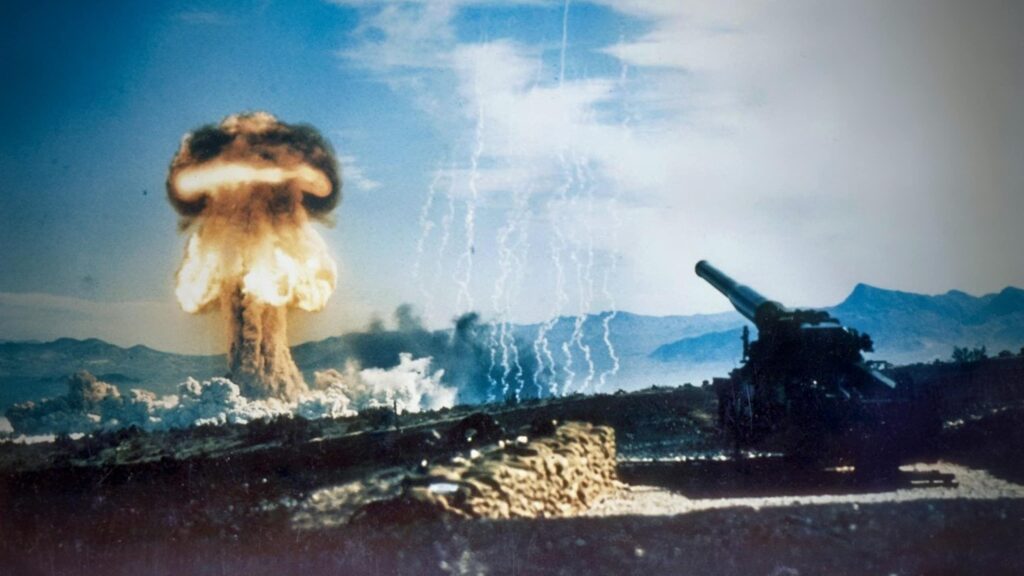
Imagine a cannon so massive it needed its own railroad car, capable of hurling a nuclear warhead 20 miles with the fury of 15,000 tons of TNT—welcome to the M65 Atomic Cannon, affectionately dubbed Atomic Annie by the soldiers who wheeled her into history. Developed in the early Cold War frenzy, this 280,000-pound behemoth was the U.S. Army’s audacious answer to Soviet tank hordes, first tested on May 10, 1953, at the Nevada Test Site. In Shot Grable, Annie lobbed an 800-pound W9 nuclear shell in a perfect parabolic arc, detonating with a mushroom cloud visible from Las Vegas. It wasn’t just a weapon; it was psychological warfare on steroids, a rolling statement that America could park atomic firepower anywhere a rail line ran, deterring Red aggression with sheer, unmissable spectacle.
But peel back the spectacle, and Atomic Annie reveals the razor-sharp ingenuity of American firearms engineering—self-propelled, hydraulically stabilized, with a recoil system that absorbed the blast of what was essentially a 280mm howitzer on nuclear steroids. Eugene Nielsen’s deep dive into her history spotlights not just the tech (like the fin-stabilized shell’s unprecedented range), but the human element: crews who nicknamed her affectionately amid the terror, and the one-and-only live nuclear firing that proved conventional artillery could go atomic. Contextually, she bridged the gap from WWII battleships to ICBMs, a transitional giant born from the same innovative spirit that birthed the M1 Garand and later the AR-15 platform—proving that scaling up power doesn’t mean sacrificing precision or mobility.
For the 2A community, Annie’s legacy is a thunderous reminder of why the Founders enshrined the right to bear arms: deterrence through overwhelming capability. In an era of urban rifle bans and mag limits, her story underscores that the Second Amendment isn’t about popguns; it’s about the people’s sovereign right to the most effective tools of self-defense, from muskets to modern suppressors. Just as Atomic Annie rolled over bureaucratic doubts to deliver unmatched firepower, 2A advocates must push back against incremental erosions—because history shows that when the state monopolizes big booms, freedom gets vaporized. She’s not just a relic; she’s a rallying cry for unapologetic American armament.


