
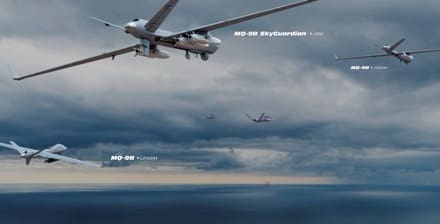
General Atomics Aeronautical Systems, Inc. (GA-ASI) just dropped a bombshell that’s got the defense world buzzing: they’re arming their flagship MQ-9B SkyGuardian and SeaGuardian drones with long-range standoff weapons, expanding these industry-leading UAS platforms into full-blown naval strike roles. Announced on February 23, 2026, from their San Diego HQ, this upgrade transforms the MQ-9B from a surveillance workhorse into a precision predator capable of launching missiles from standoff distances—think Hellfire successors or beyond-visual-range munitions that keep the drone operator safely out of harm’s way. It’s not just a tech flex; it’s a direct response to evolving threats in contested maritime environments, where carrier groups and surface fleets need eyes, ears, and teeth that can loiter for 40+ hours without risking manned assets.
Digging deeper, this development underscores a pivotal shift in asymmetric warfare, where unmanned systems like the MQ-9B—already proven in counter-ISIS ops and maritime patrols—now bridge the gap between reconnaissance and kinetic effects. GA-ASI’s move isn’t happening in a vacuum; it’s fueled by global tensions from the South China Sea to the Red Sea, where adversaries like China and Iran are fielding hypersonic threats and drone swarms. By integrating these weapons, the MQ-9B gains over-the-horizon lethality, potentially pairing with AI-driven targeting for autonomous naval interdictions. For the 2A community, this is a masterclass in technological empowerment: just as civilian AR-15s and precision optics democratize marksmanship for self-defense, these drones exemplify how scalable, standoff firepower levels the playing field against numerically superior foes. Uncle Sam isn’t hoarding this edge—it’s a reminder that innovation in arms isn’t government-exclusive; private ingenuity (GA-ASI’s roots trace to civilian aviation) drives it, much like how 2A innovators push suppressors, red dots, and modular rifles past bureaucratic hurdles.
The implications ripple far beyond the battlefield. As MQ-9B sales soar to allies like the UK, India, and Australia, we’re witnessing the proliferation of affordable, exportable strike drones that could reshape deterrence—much like how widespread 2A ownership deters tyranny at home. Critics might cry militarization, but this is evolution: long-range capabilities mean fewer boots on the ground, lower casualties, and precise force application, echoing the 2A ethos of effective resistance without mass mobilization. For gun owners and patriots, it’s vindication—firearms tech has always led military adoption (from lever-actions to modern battle rifles), and today’s drone arms race proves that armed vigilance, whether personal or projected, remains the ultimate safeguard against aggression. Keep an eye on GA-ASI; they’re not just building drones, they’re scripting the future of sovereign defense.


