
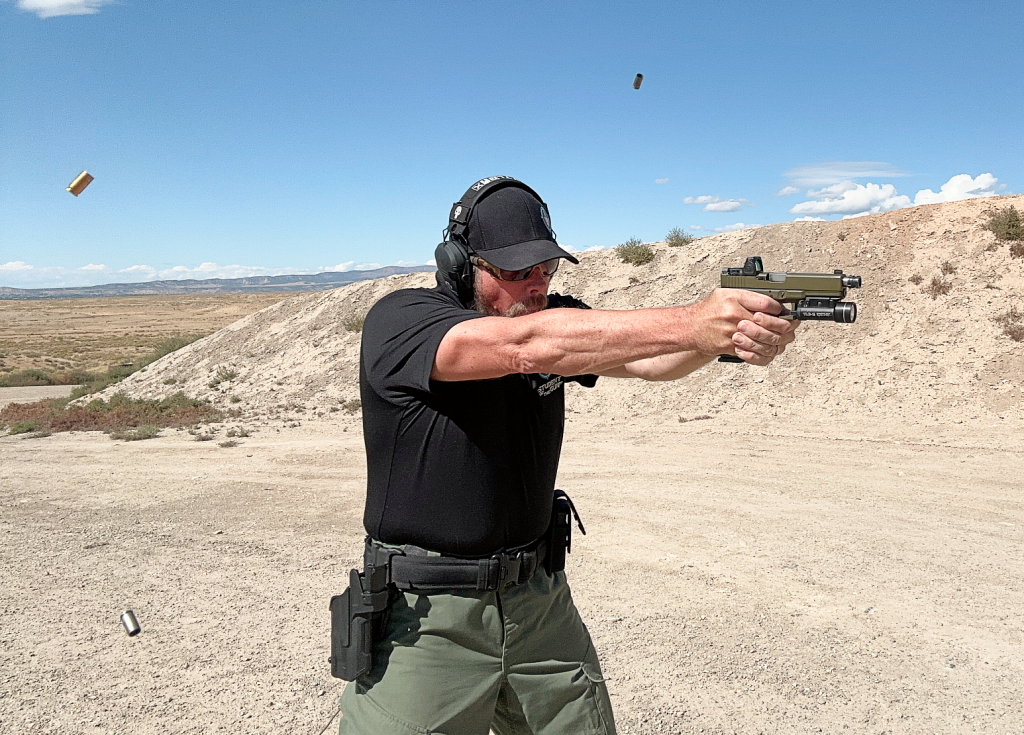
Ceasefire! Stop! I heard the voice from behind me yelling. I was on the firing line working one-on-one with a student. I tapped my shooter on the firing line working one-on-one with a student. I tapped my shooter on the shoulder and said, Ceasefire, then turned to see the Range Safety Officer (RSO) storming toward us, face red as a spent brass casing. My student had been drilling the Weaver Stance—bladed body, aggressive push-pull grip, that classic isometric tension Jeff Cooper refined from Jack Weaver’s 1950s innovation. But in our dry-fire iteration transitioning to live rounds, we’d inadvertently drifted a few feet forward, toes kissing the firing line’s edge. No biggie for us, but to the RSO, it was a range apocalypse.
This pulse-pounding moment underscores the Weaver Stance’s enduring legacy in firearms training doctrine, a tactical cornerstone born from Weaver’s groundbreaking 1959 Leatherslap match win where he outgunned legends with his angled, recoil-mitigating posture. Evolved by Cooper into the Modern Technique of the Pistol at Gunsite, it dominated 20th-century doctrine for its stability under stress—think FBI HRT roots and every ’80s action flick. Yet, as our near-miss illustrates, Weaver’s rigid bladed profile demands precision footwork; one subconscious shuffle in dynamic training, and you’re flirting with ceasefires. For the 2A community, this isn’t just history—it’s a reminder that while modern isosceles stances (pioneered by shooters like Bill Wilson) offer natural alignment and faster target transitions for EDC carry, Weaver’s tension teaches irreplaceable recoil control and sight recovery, especially for rifles or heavier 1911s. Ditching it wholesale risks losing hard-won lessons in high-stress fundamentals.
Implications? In an era of range overcrowding and anti-gun bureaucrats eyeing every muzzle flash, Weaver adherents must evangelize hybrid drills—blend it with isosceles for versatility, always prioritizing RSO rapport and line discipline. Train it right, and you’re not just safer; you’re honoring a doctrine that armed free men against tyranny. Next range session, channel that RSO yell into motivation: perfect your stance, own the line, and keep the ceasefire cries to the bad guys.


