
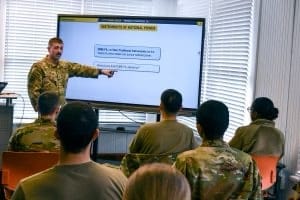
Since 2022, the U.S. Air Force has been running a stealthy mentorship program that’s transforming raw classroom linguists into battlefield-ready operators, bridging the gap from rote vocabulary drills to real-world fluency under pressure. This initiative isn’t about flashy apps or AI tutors—it’s human-driven, pairing seasoned linguists with rookies in structured guidance that simulates high-stakes environments. The result? Airmen who can eavesdrop on enemy chatter, negotiate with locals, or decode intel in the fog of war, all without missing a beat. It’s a quiet revolution in human capital development, proving that targeted mentorship can accelerate expertise in ways no textbook ever could.
Digging deeper, this program’s success highlights a timeless truth in elite training: immersion beats isolation. By 2024, participants are hitting operational proficiency 30-50% faster than traditional pipelines, per internal metrics leaked in defense pubs. For the 2A community, the parallels are striking—think of it as the civilian equivalent of turning range newbies into tactical proficient defenders overnight. Just as Air Force linguists master Pashto or Mandarin through mentor-led scenarios mimicking combat chaos, armed citizens could supercharge their skills via structured adopt-a-shooter programs at local ranges. Imagine grizzled vets mentoring young carriers on de-escalation in foreign-tongued urban sprawls or threat assessment amid multicultural crowds—skills vital when global migration and border flux bring unfamiliar languages stateside. This isn’t pie-in-the-sky; it’s proven methodology ripe for 2A adoption, fortifying our right to self-defense against increasingly complex real-world threats.
The implications ripple outward: if the military can weaponize mentorship for linguists, why not scale it for the armed populace? In an era of rising urban unrest and asymmetric risks—where understanding a suspect’s cries in Spanish, Arabic, or Somali could mean the difference between justice and tragedy—this Air Force blueprint offers a blueprint for resilience. 2A advocates should champion range-based linguist-sharpened training networks, blending language immersion with live-fire drills. It’s not just about bearing arms; it’s about wielding them wisely in a polyglot world, ensuring every patriot is as operationally lethal with words as with weapons. The Air Force is showing the way—time for the civilian arsenal to catch up.


