

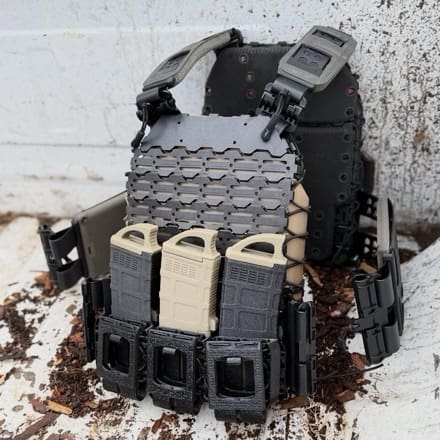
Back in 2006, as the wars in Iraq and Afghanistan raged on, a prescient gear guru penned a bold prediction in the intro to *Battle Rattle*: the days of stitching fabric plate carriers were numbered. No more needles and thread—future load carriage would bond via glue or welding, ushering in lighter, tougher rigs for the warfighter. Fast-forward nearly two decades, and Beecher Tactical is flipping that script with pure additive manufacturing wizardry. They’ve 3D printed an entire plate carrier, ditching traditional textiles altogether for a monolithic polymer beast that’s as innovative as it is provocative. This isn’t some garage tinkerer’s prototype; it’s a functional, field-ready evolution that challenges the sacred cows of tactical gear design.
What makes this a game-changer? Peel back the layers, and Beecher’s print exploits the magic of fused deposition modeling (FDM) or similar tech to create seamless, lattice-structured panels that integrate cummerbunds, shoulder straps, and placard mounts in one go. No seams to chafe, no weak points to rip under a 20-pound plate stack—it’s inherently stronger where it counts, with optimized weight distribution that could shave ounces off your kit without sacrificing MOLLE real estate. Cleverly, they’ve tuned the infill for breathability and flex, mimicking the ventilation of high-end fabrics while adding rigidity for heavy loads. For the 2A community, this hits like a suppressed .300 BLK: democratized manufacturing means you can iterate designs at home with a decent printer, sidestepping supply chain chokepoints from Big Army contractors. Imagine customizing carriers for your exact build, plate size, or even embedding RFID blockers or quick-release mag pouches—pure empowerment in an era of ATF scrutiny over ghost everything.
The implications ripple far beyond range days. As 3D printing matures, Beecher Tactical signals the death knell for mass-produced, one-size-fits-most carriers hawked at SHOT Show. For preppers, hunters, and defenders stocking the Magpul bunker, this heralds affordable, untraceable armor solutions that scale from budget builds to boutique perfection. Sure, skeptics will gripe about durability under mud and blood (early prints can be brittle if not engineered right), but Beecher’s proof-of-concept crushes that narrative—it’s battle-rattle reimagined for the maker generation. Pro-2A patriots, fire up your Ender 3s; the fabric era is over. Grab the STL files, print your freedom vest, and gear up for whatever’s next.


