
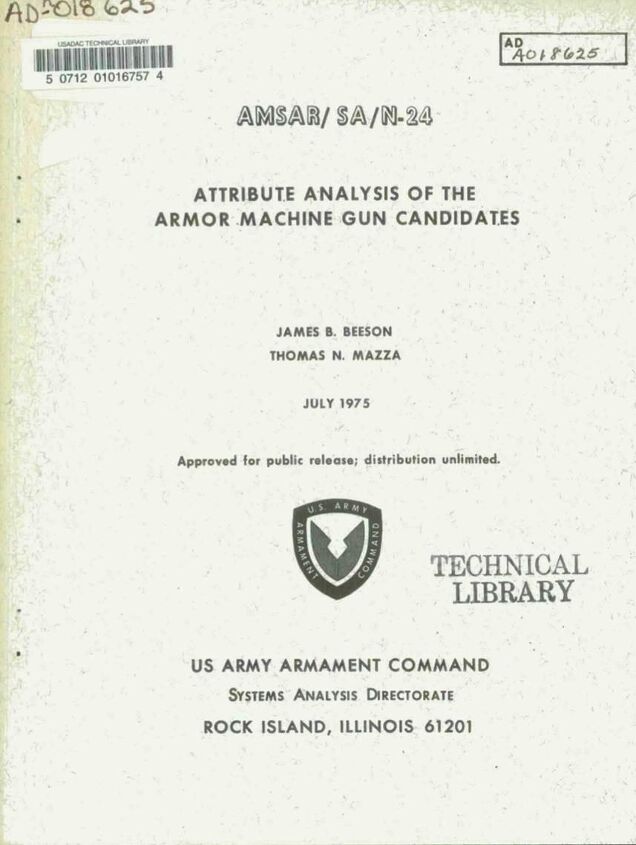
In the sweltering summer of 1975, as the Vietnam War’s echoes still lingered and the U.S. military grappled with the M60’s reliability woes, an Army engineering team at Aberdeen Proving Ground quietly put the Soviet PKM through its paces. This wasn’t some classified black-ops trial; it was a straightforward attribute analysis of off-the-shelf 7.62mm machine guns, hunting for a coaxial replacement to the finicky General Electric M219. The PKM, Kalashnikov’s belt-fed evolution of the RPD, arrived stateside via shadowy intelligence channels—likely captured in Vietnam or procured through allies. Testers fired thousands of rounds, dissecting everything from cyclic rates (650 rpm) and barrel life (over 30,000 rounds before accuracy degradation) to its featherweight 16.3-pound empty heft. The report, one of the few declassified gems surfacing publicly, praised the PKM’s simplicity: stamped steel construction, no finicky gas piston adjustments, and a design so rugged it laughed off mud, sand, and neglect that would choke an M60.
Digging deeper, the PKM’s standout was its engineering elegance—forged from wartime lessons the Soviets learned the hard way, prioritizing mass production over precision machining. U.S. testers noted its superior sustained fire capability, with quick-change barrels and a non-adjustable gas system that just worked, clocking mean rounds between stoppages (MRBS) far above Western counterparts. Compared to the M60’s 23-pound bulk and maintenance diva status, the PKM was a revelation: cheaper to build, easier to field-strip, and brutally effective at 800 meters effective range. Yet, Cold War paranoia killed any adoption talk; no American brass wanted to echo Soviet designs. Fast-forward to today, and this test underscores a timeless truth: the best guns win on merit, not politics.
For the 2A community, the PKM saga is pure catnip—proof that civilian access to semi-auto analogs like the Zenith ZF-5 or even registered MGs (if you can navigate the Hughes Amendment labyrinth) democratizes elite military tech. Imagine belt-feds at the range outlasting ARs in harsh conditions; it’s a blueprint for why import bans sting, stifling innovation while adversaries iterate. As ATF regs tighten, this 1975 report reminds us: robust, simple designs like the PKM don’t just survive; they dominate. Time to stockpile 7.62 belts and push for fewer barriers—because when Uncle Sam tests foreign iron and it shines, that’s your cue to own the civilian slice.


