
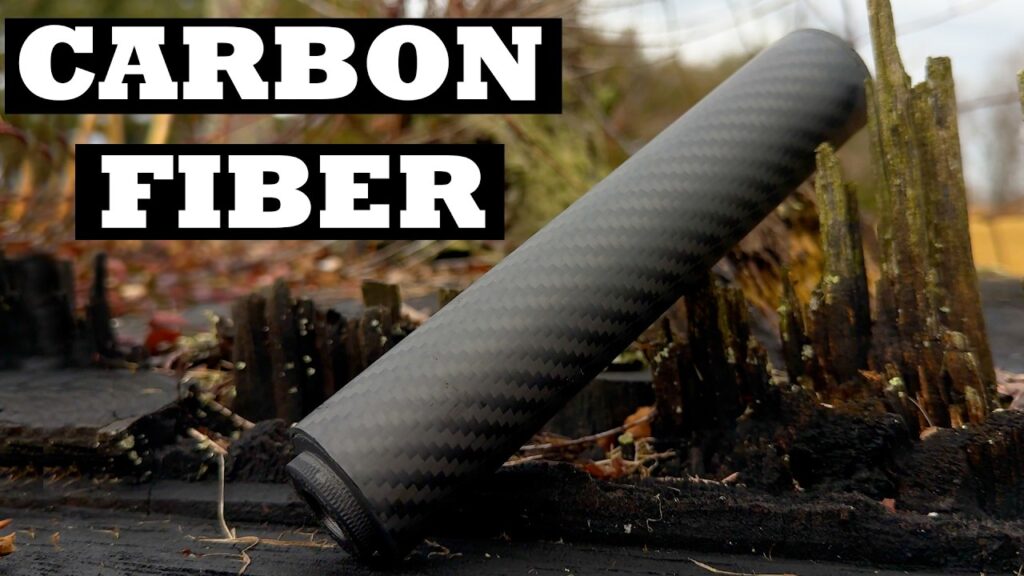
Imagine a suppressor for your .22 that’s not just whisper-quiet but also lighter than your favorite coffee mug, cheaper to produce, and built entirely from carbon fiber—no titanium, no Inconel, just woven wizardry from the world of aerospace and supercars. That’s the bold promise of the Pindrop XL from AAC Enterprise, a fully additive-manufactured rimfire can that’s turning heads in the suppressor scene. We’re talking maximum sound suppression without the heft or premium price tag of traditional metal cans, all while clocking in at featherweight status. The source dives into real-world testing to answer the million-dollar question: can carbon fiber hack it in the high-heat, high-pressure world of suppressors, or is this just another lightweight gimmick destined for the scrap heap?
Let’s break it down with some pro-level analysis. Carbon fiber’s tensile strength crushes aluminum and rivals titanium at a fraction of the cost—perfect for 2A enthusiasts tired of dropping $500+ on .22 cans that weigh as much as a brick. Additive manufacturing (think 3D printing on steroids) lets AAC iterate baffles and expansion chambers with surgical precision, optimizing for subsonic .22LR’s pressure curve without the waste of CNC machining. Early tests hint at industry-leading dB reduction—potentially dipping below 110dB on a Ruger 10/22—while keeping POI shift minimal and zero lead-up time. But here’s the rub: carbon’s heat dissipation is legendary in F1 cars, yet suppressors live in a cyclic hell of 1,000°F blasts. If it holds up without delaminating or cracking after 1,000 rounds, this could democratize suppression like the Ti-only cans did a decade ago, slashing barriers for new NFA owners.
For the 2A community, Pindrop XL isn’t just a product—it’s a paradigm shift. With ATF wait times dragging and Form 1 e-filing surging, low-cost, lightweight rimfire suppressors like this fuel the plinking revolution, making SBR’d pistols and backyard trainers viable for everyone from casual shooters to competition rimfire pros. If testing proves durability (and we’re betting it does, given AAC’s track record), expect a flood of carbon-fiber imitators, driving prices down and innovation up. This is 2A evolution: lighter, quieter, cheaper—proving once again that American ingenuity keeps the Second Amendment locked and loaded. Stay tuned for full test results; your .22 arsenal might never be the same.


