
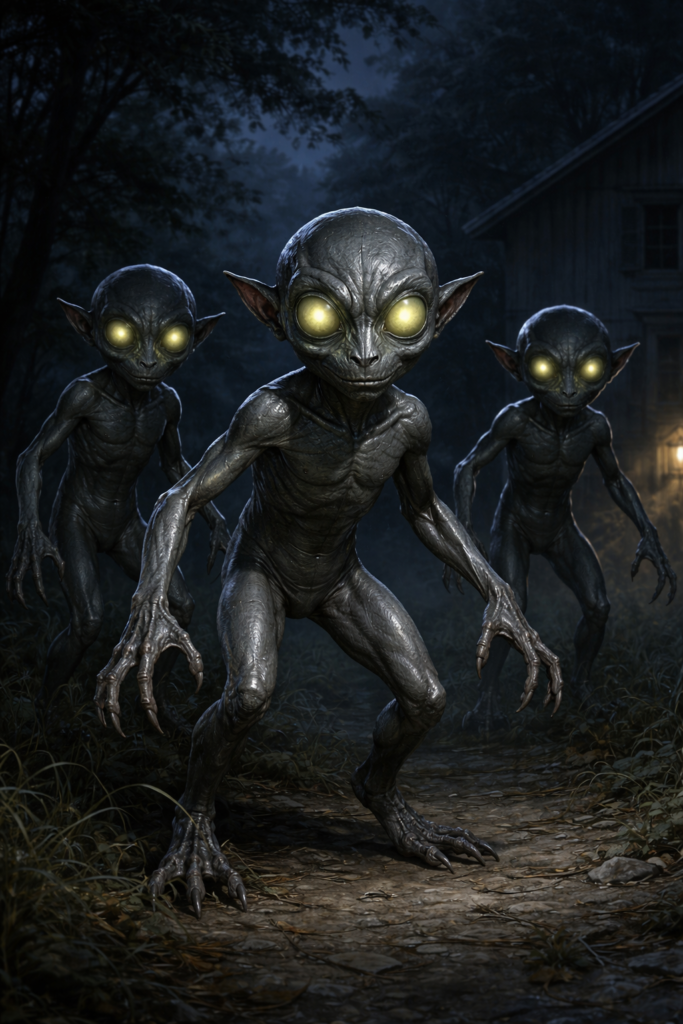
In the sweltering summer night of August 21-22, 1955, near the small town of Kelly-Hopkinsville, Kentucky, two families barricaded themselves inside a farmhouse amid what they described as an unrelenting siege by otherworldly creatures—small, glowing goblins with oversized heads, glowing yellow eyes, silver-gray skin, and arms that stretched like rubber. The Hopkinsville Goblins incident began when Billy Ray Taylor spotted a UFO streaking across the sky, followed by the appearance of these 3-4 foot tall beings that floated, impervious to bullets, and seemed to taunt the terrified residents. Over hours, the men—armed with shotguns and rifles—fired dozens of rounds at the intruders, who would slump after hits only to rise again, their bodies emitting sparks or oily residue. Local police, state troopers, and even Air Force investigators arrived to find bullet-riddled walls, spent shells everywhere, and traumatized witnesses whose stories held up under intense questioning. No hoax was ever proven, and the case remains one of UFOlogy’s most compelling high strangeness events, inspiring books, documentaries, and even a Little Green Men Days festival in Hopkinsville today.
What elevates this yarn beyond campfire fodder is its gritty, boots-on-the-ground realism—two rural Kentucky families, steeped in self-reliance, instinctively grabbing their firearms to defend hearth and home against an incomprehensible threat. The goblins didn’t knock politely; they clawed at windows, hovered menacingly, and shrugged off .22s and 20-gauge blasts like comic book villains. Investigators noted the sheer volume of ammo expended (estimates range from 50-150 rounds), with no signs of fabrication amid the chaos. This wasn’t urban myth-spinning; it was a testament to 2A ethos in action—ordinary folks exercising their natural right to keep and bear arms when the thin blue line was hours away and something unnatural was scratching at the door. Skeptics chalk it up to owls, meteors, or moonshine, but the consistency of eyewitness accounts from sober, unrelated parties defies easy dismissal.
For the 2A community, the Hopkinsville saga is a stark reminder of why the Second Amendment isn’t about hunting ducks or sporting clays—it’s the ultimate insurance policy against the unknown, be it two-legged tyrants, four-legged beasts, or whatever those Kentucky night stalkers truly were. In a world of escalating weirdness—from drone swarms to unexplained aerial phenomena reported by Pentagon insiders—the armed citizen stands as the first, best line of defense. Imagine if those families had been disarmed by feel-good legislation; the outcome could’ve been tragedy, not legend. This story underscores that preparedness isn’t paranoia—it’s prudence, etched in bullet holes and goblin lore, urging us to keep our powder dry for threats that defy explanation.


