

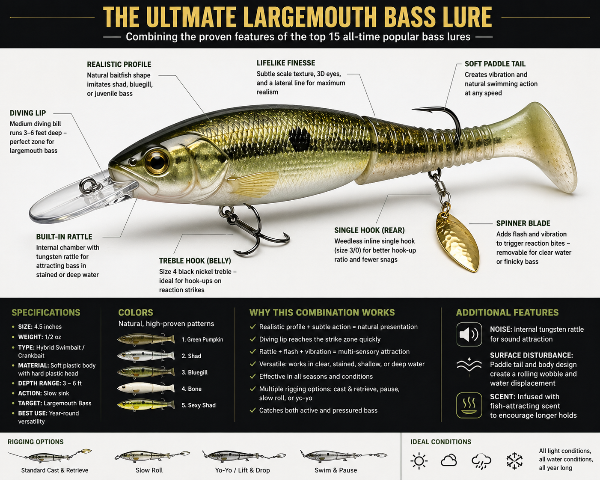
Imagine a world where artificial intelligence doesn’t just predict bass strikes—it designs the ultimate lure by deconstructing decades of angling dominance. The source text nails it: spinnerbaits with their vibration and flash, crankbaits’ wobble and dive, soft plastics’ undulating swim, jigs’ bottom-hugging precision, swimbaits’ lifelike thrash, blade baits’ erratic dart, and topwaters’ explosive surface commotion. AI strips these to their DNA—essential traits like action, profile, sound, and buoyancy—then fuses them into one hybrid monster. No more tacklebox Tetris; this is the singularity of fishing gear, potentially revolutionizing how we chase largemouths across North America’s waters.
But here’s the clever twist for us 2A enthusiasts: this isn’t just about hooks and treble; it’s a masterclass in optimization under constraints, mirroring the endless innovation in firearms design. Think AR-15 platforms—modular receivers blending the reliability of a battle rifle with the adaptability of a varmint hunter, much like AI merging crankbait depth with topwater splash. Or precision rifles where ballistics algorithms refine twist rates and barrel profiles, echoing how AI crunches catch data to perfect lure cadence. The implications? As AI democratizes elite design (no PhD in hydrodynamics required), it empowers everyday shooters to 3D-print custom suppressors or optimize red-dot reticles via open-source models. Bass pros get their one lure to rule them all; gun owners get bespoke 2A tools without Big Gun bureaucracy.
The ripple effect hits hard: if AI can eclipse 50 years of human lure evolution in a simulation sprint, what’s stopping it from blueprinting the next gen of compact carry pistols or suppressor-optimized barrels? This story curates a pro-innovation wake-up call—embrace the tech, or get left casting relics while the future hooks the big ones. For 2A, it’s not hype; it’s hardware evolution accelerating faster than a .308 muzzle blast. Dive in, tinker, and stay armed with ingenuity.


