
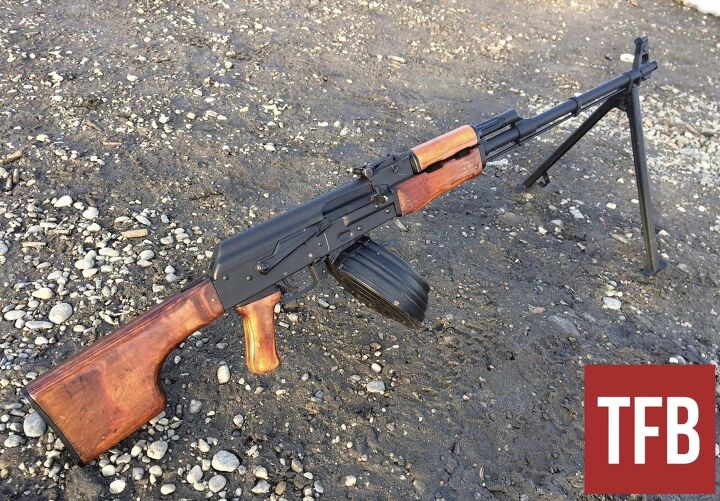
In the gritty calculus of Cold War warfare, the Soviets made a fateful call in the late 1950s: ditch the belt-fed thunder of the RPD light machine gun for the RPK, an AK-47 derivative that traded sustained suppressive fire for the holy grail of military logistics—commonality. Adopted in 1959, the RPK kept the same 7.62x39mm cartridge, shared magazines and key components with the AK platform, and slashed training time since every conscript already knew how to run an AK. It was a masterstroke of pragmatism for a sprawling empire churning out millions of rifles for Warsaw Pact hordes and Third World proxies. No more juggling separate belts, tripods, and barrel swaps under fire; just slap on a longer barrel, a bipod, and a bigger mag, and you’ve got squad-level automatic fire that’s dead simple to field-maintain in the mud of Afghanistan or the jungles of Angola. The RPK wasn’t about outgunning the enemy—it was about drowning them in sheer numbers of reliable, interchangeable guns.
But let’s peel back the propaganda: this compromise exposed the RPK’s Achilles’ heel. The RPD could hose down a position with 100-round belts at a steady 650-750 rpm, cooling efficiently for prolonged bursts that pinned NATO troops in Korea. The RPK? Limited to 40- or 75-round drums that cooked off after a couple magazines, forcing barrel changes or risky swaps mid-fight. Soviet doctrine leaned hard into massed infantry assaults, where volume of fire from many rifles trumped precision suppression from a few specialized guns—echoing the human-wave tactics that nearly bled the Wehrmacht dry in WWII. Critics called it a downgrade, but data from conflicts like the Yom Kippur War (where captured RPKs saw action) showed it held up: lighter (10.8 lbs vs. RPD’s 16.3 lbs), more mobile, and with over 1 million produced, it became the backbone of motorized rifle squads.
For the 2A community, the RPK saga is a blueprint for why modularity crushes bespoke designs in real-world SHTF. American civilians can mirror this with AK builds—slap a Romanian RPK lower on your WASR-10 parts kit, add a Tapco stock and bipod, and you’ve got a semi-auto squad support gun that’s 922r compliant and sips the same PMAGs as your rifle squad. It screams the Second Amendment ethos: commonality means faster resupply from your ammo hoard, simpler training for family defenders, and logistics that laugh at supply chain disruptions. While belt-feds like the M249 SAW demand fedco belts and gucci maintenance, the RPK ethos empowers the everyman militiaman. In a world eyeing renewed great-power scraps, ditching capability for commonality isn’t compromise—it’s survival smart. Grab a Draco, build up, and channel that Soviet efficiency before the balloon goes up.


