
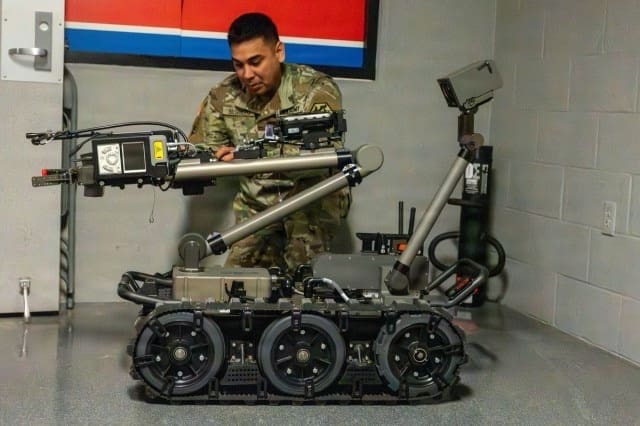
FORT LEONARD WOOD, Mo. — The U.S. Army’s Chemical Defense Training Facility (CDTF) at the Maneuver Support Center of Excellence is revolutionizing how chemical soldiers tackle site exploration, deploying man-transportable robotic systems (MTRS) in ways that go far beyond their standard playbook. These rugged bots, already a staple in military ops for scouting hazardous zones, are now being woven into hands-on training scenarios where soldiers direct them through simulated chemical hotbeds—think nerve agents, blistering toxins, and radiological threats—without risking human life. Instructors aren’t just demoing; they’re turning recruits into robot wranglers, enhancing decision-making in real-time under duress. It’s a leap from clunky remote viewing to intuitive, tactical mastery, slashing exposure risks and boosting mission efficiency.
This isn’t just a tech glow-up for chem troops—it’s a masterclass in asymmetric warfare tools that every 2A advocate should clock. MTRS-like platforms echo the civilian drone boom we’ve seen explode post-2020, where armed Americans have turned off-the-shelf quadcopters into force multipliers for property defense and rural surveillance. Imagine scaling that to personal robotics: compact, rugged bots scouting perimeters, relaying live feeds of intruders laced with who-knows-what (chemical irritants? Nah, just flashbangs and thermals for now). The Army’s pivot underscores a broader DoD trend toward unmanned systems, with budgets surging 20% yearly per recent GAO reports, signaling these techs will trickle down to consumer markets faster than you can say NDAA procurement. For the 2A community, the implication is crystal: as feds hone robot-human teams for defense, innovators in the private sector—like those tweaking Boston Dynamics knockoffs or DJI mods—need to outpace with armed, civilian-legal variants. It’s not sci-fi; it’s the next frontier in self-reliance, where your backyard R&D lab beats Uncle Sam’s playbook.
The ripple effects? Enhanced soldier survivability translates to policy pushes for domestic drone regs that could crimp 2A-aligned tech adoption—witness the FAA’s ongoing FPV restrictions mirroring military no-fly zones. But here’s the pro-2A silver lining: this CDTF innovation democratizes high-stakes recon, arming enthusiasts with blueprints to build resilient homestead defenses. Stay vigilant; as robots transform chemical training today, they’ll redefine personal sovereignty tomorrow. Gear up, tinker, and lobby—because in the robotics arms race, the Second Amendment demands we’re not just observers.


