
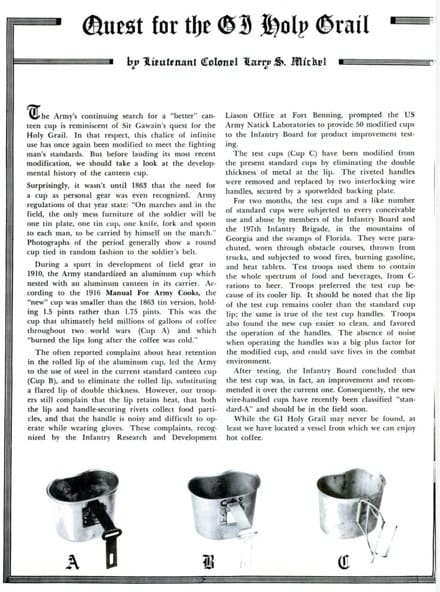
In the gritty pages of the May-June 1972 issue of Infantry Magazine, Lieutenant Colonel Larry S. Mickel embarks on a Quest for the GI Holy Grail, chronicling the humble canteen cup’s evolution from World War I field trials to its pinnacle as the infantryman’s indispensable sidekick. Far from a mere thirst-quencher, this stainless steel chalice—stackable, nestable, and tough as nails—served as stove, cook pot, and survival tool, boiling coffee over a foxhole fire or simmering C-rations under duress. Mickel’s piece isn’t dry history; it’s a love letter to ingenuity born of combat necessity, tracing prototypes from the doughboy era’s leaky aluminum flops to the M1910’s enduring design tweaks that made it Vietnam-proof. Soldiers swore by it, customizing with wire bail handles or etching names, turning mass-produced gear into personal talismans of resilience.
What elevates this relic to legend is its embodiment of minimalist perfection: lightweight at under 4 ounces, it fit the M1 Garand pouch or M16 scabbard like it was ordained, enabling self-sufficiency in the field without logistical bloat. Mickel cleverly dissects the Army’s procurement ping-pong—endless specs refined through blood and feedback loops—highlighting how real-world warriors, not deskbound engineers, drove iteration. For the 2A community, this saga resonates deeply: just as the canteen cup outlasted faddish replacements, the civilian AR-15 platform thrives on modular simplicity, echoing the rifleman’s ethos of one tool, infinite missions. It’s a reminder that Second Amendment rights aren’t about gadgets but enduring tools for defense and independence, much like that dented cup still rattling in surplus stores today.
The implications ripple into modern prepping and tactical culture, where 2A enthusiasts hoard these holy grails alongside black rifles and ammo caches. In an era of over-engineered gear, Mickel’s quest underscores why the originals endure—battle-tested, unpretentious, and fiercely practical. Next time you nestle a canteen cup in your kit, tip your hat to the GIs who forged it in fire; it’s not just nostalgia, it’s a blueprint for self-reliant liberty that no bureaucracy can dilute.


