

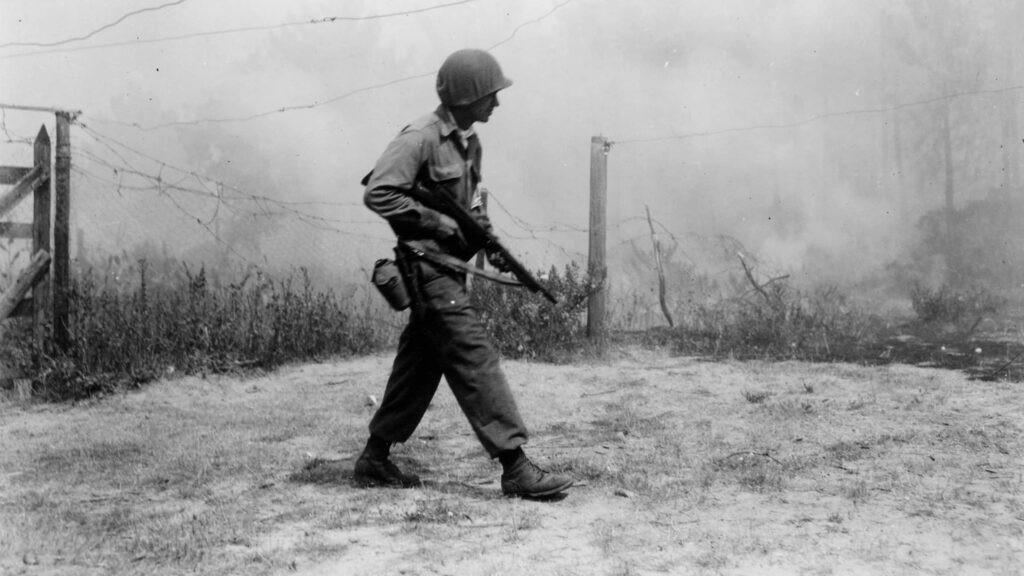
In the summer of 1944, a young paratrooper named Bill found himself dropped into Normandy with little more than his wits, his M1 Garand, and an unauthorized Thompson submachine gun he had liberated from a supply crate back in England. While most soldiers carried the standard-issue rifle, Bill’s “Tommygun” gave him a decisive edge in the hedgerow fighting that followed—its 600-round-per-minute cyclic rate turning German counterattacks into brief, one-sided firefights. What makes the story remarkable is not just the weapon’s lethality, but the quiet defiance it represented: an individual soldier deciding that the best tool for the job was the one the bureaucracy had not issued him. For today’s Second Amendment community, Bill’s choice echoes the timeless argument that an armed citizen’s judgment often outpaces institutional gatekeeping.
The Thompson’s own history only deepens the lesson. Born in the trenches of World War I and later immortalized by Prohibition-era gangsters, the gun was already a cultural lightning rod by the time Bill carried it into France. Its 45 ACP cartridge delivered stopping power that modern pistol-caliber carbines still chase, while its simple blowback action proved rugged enough for airborne drops and muddy foxholes alike. Yet the same qualities that made the Thompson indispensable on the battlefield—compact size, high capacity, and ease of use—later fueled the very restrictions that now limit civilian ownership of similar firearms. Bill’s story therefore serves as both tribute and warning: the tools that win wars are frequently the same ones later demonized by those who never had to fight with them.
For 2A advocates, the takeaway is straightforward. Rights exercised under duress are rights preserved for future generations. Bill did not wait for permission to arm himself optimally; he recognized that the right to keep and bear arms is ultimately about matching the citizen’s capability to the threat at hand. In an era when magazine bans, “assault weapon” rhetoric, and bureaucratic delays threaten to disarm law-abiding Americans, his unauthorized Thompson stands as a reminder that preparedness has always required a measure of quiet rebellion. The hedgerows of Normandy may be quiet now, but the principle Bill embodied—individual judgment over institutional restriction—remains very much alive.


