

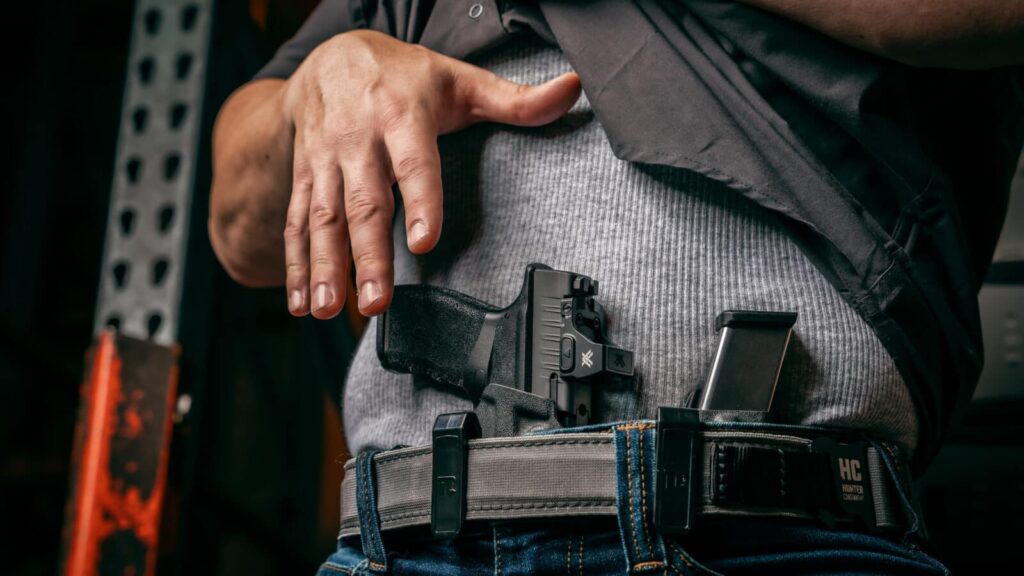
Tucked-shirt carry has quietly become one of the most practical—and most overlooked—concealed-carry disciplines for the everyday citizen who still wants to look like a civilian instead of a walking tactical billboard. The technique hinges on a simple wardrobe hack: an untucked overshirt or lightweight jacket that can be lifted with the support hand while the dominant hand draws from an appendix or strong-side holster. What makes this method noteworthy is how it sidesteps the usual “printing versus comfort” compromise; the outer layer breaks up the outline of the firearm while still granting immediate access, a balance that matters more than ever in an era when anti-gun municipalities are emboldened to harass permit holders over the slightest visual cue of a weapon.
For the 2A community, the resurgence of tucked-shirt methods is both a tactical refinement and a cultural statement. It underscores that lawful carriers are not obligated to telegraph their preparedness to satisfy someone else’s sense of aesthetics or safety theater. Instead, they can maintain a low-profile presence that respects both personal liberty and social decorum—an approach that quietly reinforces the argument that millions of Americans carry responsibly without incident. Moreover, the technique dovetails with the growing ecosystem of minimalist, AIWB-focused holsters and claw-equipped grips designed to tuck deeper while remaining grippable under pressure.
Ultimately, tucked-shirt carry is a reminder that effective self-defense is less about gadgetry and more about practiced, adaptable skill sets. As more states expand constitutional carry and the cultural battle over public carry intensifies, citizens who master low-signature draws will continue to prove that the right to bear arms and the right to blend in are not mutually exclusive—they’re complementary pillars of a free society.


