

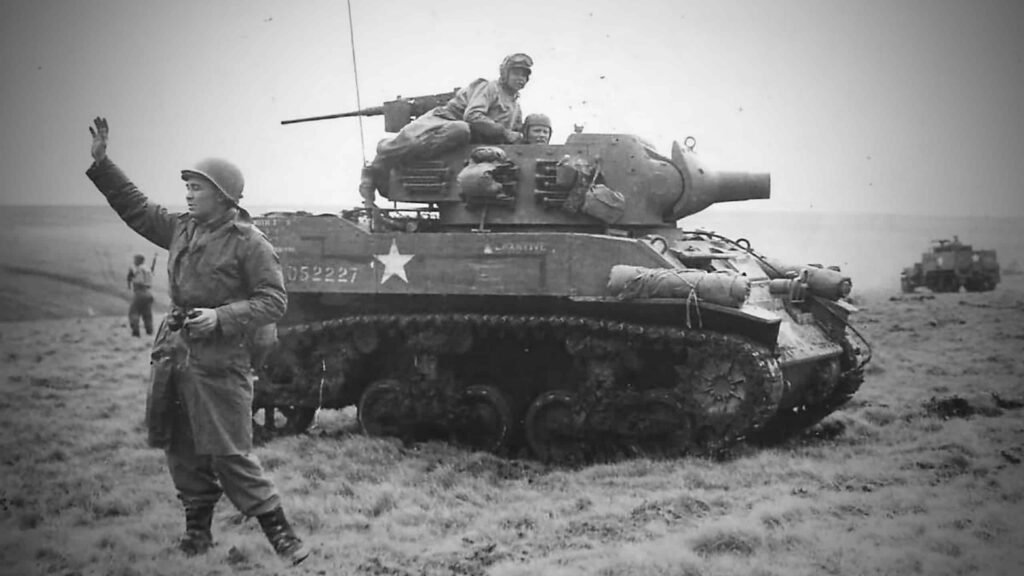
The M8 Howitzer Motor Carriage turned the reliable M5 Stuart chassis into a mobile 75 mm howitzer platform that could keep pace with fast-moving armored columns while delivering indirect fire support that standard tank guns simply couldn’t match. By marrying the Stuart’s proven automotive reliability with a howitzer’s plunging trajectory, the M8 gave commanders a lightweight, air-transportable artillery piece that could be rushed forward to suppress enemy positions or break up counterattacks before heavier self-propelled guns arrived. That same engineering mindset—taking an existing, battle-proven chassis and re-purposing it for a new mission—still resonates with today’s 2A community, where builders routinely adapt modern sporting rifles, optics, and accessories to meet evolving defensive needs without waiting for government programs to catch up.
What makes the M8 story especially relevant is the reminder that mobility plus firepower equals deterrence. In 1944-45, small units equipped with these vehicles could shift artillery support across rough terrain faster than towed batteries, giving American forces a decisive edge in fluid European and Pacific campaigns. The parallel for today’s gun owners is clear: a well-equipped citizen with a versatile rifle, quality optics, and the training to employ both can project force across a homestead or neighborhood far more effectively than a static safe full of long guns. The M8’s success also underscores why restrictions on magazine capacity, barrel length, or accessory configuration so often miss the mark—history shows that the platform that wins is the one that can be rapidly reconfigured, not the one that regulators pre-approved.
Finally, the M8’s post-war fate illustrates how yesterday’s “assault gun” becomes tomorrow’s historical footnote once the battlefield moves on. Surplus M8s were scattered to Allied nations and later civilian collections, proving that yesterday’s military hardware often ends up in private hands without apocalyptic consequences. That pattern continues with today’s semi-automatic rifles and optics: yesterday’s “military-grade” features migrate into civilian use, improve marksmanship, and strengthen the very individual preparedness the Second Amendment was written to protect. The lesson is simple—innovation in firearms, whether on a Stuart chassis or a modern AR platform, has always outpaced the fears of regulators, and the 2A community’s job is to keep that tradition alive.


