

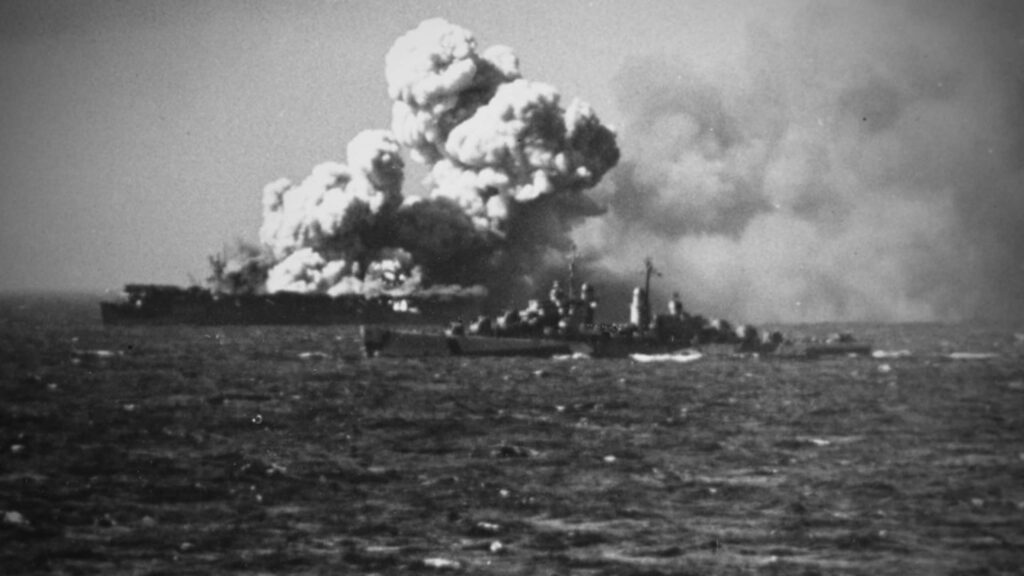
In the cauldron of World War II’s Pacific Theater, the Battle of Leyte Gulf in October 1944 stands as the death knell for the Imperial Japanese Navy—a cataclysmic clash that shattered Japan’s naval supremacy and paved the way for Allied victory. Curated from Peter Suciu’s sharp historical analysis, this wasn’t just a battle; it was an extinction event. Picture it: Admiral Halsey’s aggressive dash north chasing a decoy carrier force left San Bernardino Strait perilously unguarded, allowing Yamamoto’s successors to hurl their remaining battleships, cruisers, and destroyers into a desperate all-or-nothing gamble. The ensuing four-day melee across the Sibuyan Sea, Surigao Strait, and Samar saw over 200 Allied warships dismantle Japan’s fleet, sinking four carriers, three battleships, and countless escorts while losing only lighter vessels. Suciu nails the irony: Japan’s vaunted decisive battle doctrine, honed on steel behemoths like the Yamato, crumbled against the nimble, carrier-centric U.S. Navy, proving that centralized, top-down naval power couldn’t match decentralized, adaptive tactics.
Dig deeper, and Leyte Gulf whispers timeless lessons echoing straight to the 2A community. Japan’s navy embodied the perils of consolidated might—massive, government-controlled armadas vulnerable to bold improvisation, much like how tyrants throughout history have sought to monopolize firepower. The U.S. triumph hinged on distributed command: task groups operating autonomously, pilots and gunners making split-second calls without micromanagement from Pearl Harbor. Sound familiar? It’s the essence of the Second Amendment—a bulwark for citizen-soldiers wielding personal arms against overreaching states. When Taffy 3’s scrappy destroyer escorts charged into the jaws of Kurita’s battleships off Samar, outgunned 1-to-10 yet inflicting chaos through sheer audacity and individual resolve, they mirrored the armed citizenry’s role in checking centralized aggression. History’s verdict is clear: disarm the people, centralize the guns, and you breed fragility, as Japan learned when her navy evaporated, leaving islands defenseless.
For 2A patriots, Leyte isn’t dusty trivia—it’s a clarion call. In an era of creeping gun grabs and elite-driven common sense reforms, this battle reminds us that true security flows from the distributed lethality of free men with rifles, not bureaucratic fleets. As Suciu’s piece underscores, empires fall when they bet everything on control; they endure when power rests with the many. Arm up, stay vigilant—history favors the prepared.


