

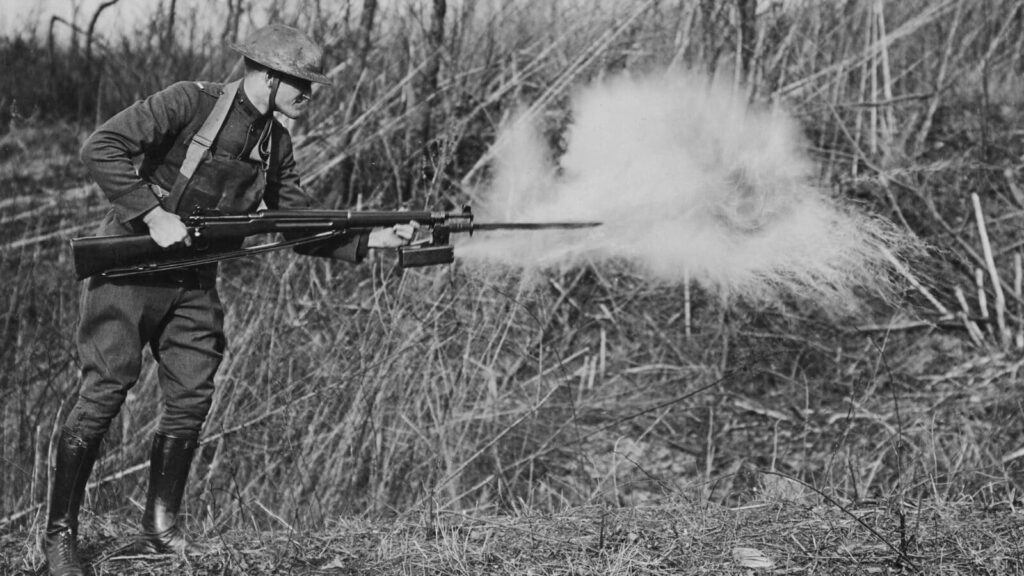
America’s doughboys stormed the trenches of World War I not just with rifles and grit, but with a fiery secret weapon that turned the tide in brutal close-quarters carnage: the Model 1917 bayonet flamethrower adapter. This ingenious contraption, developed by the U.S. Army’s Chemical Warfare Service, screwed onto the end of a Springfield M1903 rifle, transforming it into a short-range inferno projector. Fed by a backpack tank of flammable mix—often a nasty cocktail of oil, gasoline, and thickened agents—it spewed 30-foot jets of flame capable of incinerating German defenders hiding in bunkers or foxholes. First seeing action at the Battle of Meuse-Argonne in late 1918, these flaming bayonets inflicted psychological terror, flushing out enemies who thought concrete and earth could shield them. Over 1,000 units were produced, but their late-war debut meant they scorched fewer foes than they did Allied imaginations, proving that American ingenuity could weaponize fire on the cheap.
What makes this a powder keg for 2A enthusiasts? It’s a stark reminder that the rifle—our constitutional cornerstone—isn’t just a tool for precision or defense; it’s a modular platform primed for innovation under pressure. The M1917 adapter epitomizes the Founding Fathers’ vision of a well-regulated militia equipped with cutting-edge lethality, echoing how minutemen adapted muskets with everything from buck-and-ball loads to improvised grenades. In an era of ATF overreach and accessory bans, this WWI relic underscores the absurdity of regulating assault weapon features like bayonet lugs—features that, as history shows, enable life-saving adaptability. Imagine if modern AR-15 owners were stripped of rails, grips, or suppressors; we’d be as neutered as post-Versailles Germans, who got their flamethrowers yanked first.
The implications ripple into today’s battlespace: with urban warfare and home defense blurring lines, flame-based countermeasures (think legal civilian thermobarics or non-lethal incendiaries) could redefine self-reliance. The 2A community should champion this history to dismantle narratives painting firearms as static relics— they’re evolutionary engines of survival. Dig into declassified Army docs or replicas from firms like Thermate Company, and you’ll see why shall not be infringed isn’t hyperbole; it’s a mandate for flaming forward.


