

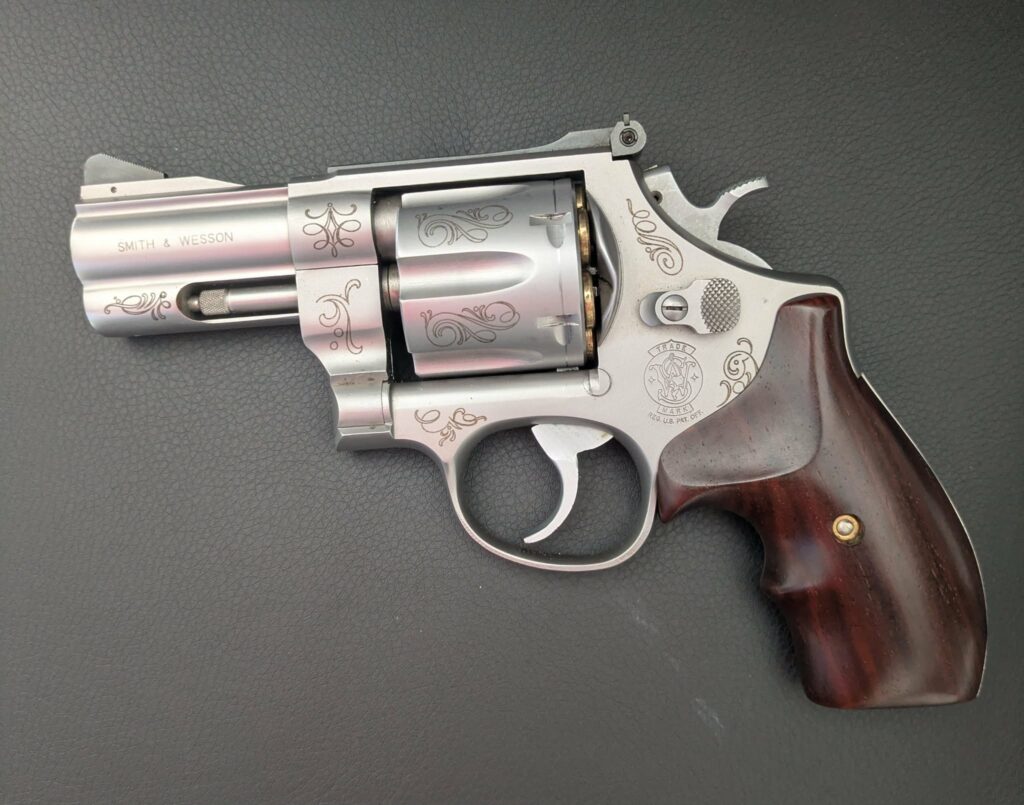
For more than three decades, a single engraved Smith & Wesson Model 625 has been doing exactly what its designers intended—riding in a holster, absorbing recoil, and earning its keep as a working revolver rather than a safe queen. That longevity matters because it quietly refutes the modern narrative that only polymer-framed, optics-ready pistols deserve the label “practical.” The 625’s .45 ACP cylinder, N-frame heft, and classic lock-up have shouldered everything from everyday carry to formal competition, proving that a revolver’s simplicity can still outperform complexity when the chips are down. In an era when some states treat magazine capacity as a political football, the six-shot wheelgun’s independence from feeding devices becomes more than nostalgia; it is a tangible reminder that rights are exercised by hardware that functions, not by hardware that merely looks tactical on a range table.
What elevates this particular revolver from anecdote to parable is the engraving itself—scrollwork laid over honest wear, a literal etching of the owner’s story onto the firearm’s steel. That marriage of artistry and abrasion embodies the 2A ethos that guns are tools first and talismans second. Collectors who cocoon their blasters in silicone socks may preserve finish, but they also forfeit the lived history that turns an object into an heirloom. When the next owner inherits the 625, the wear patterns will tell as much about freedom as the engraving does: a finish thinned by thousands of draws, a cylinder face kissed by primers, perhaps a grip frame smoothed by the same hand that signed the original purchase paperwork in 1991. Such continuity is living proof that the right to keep and bear arms is not a static clause in aged parchment but a continuum renewed every time a working gun is cleaned, carried, and passed forward.
For the broader community, the revolver’s saga underscores why incremental restrictions on “features” or manufacturing dates are ultimately self-defeating. A gun built when Reagan was president still serves its owner today precisely because no lawmaker inserted an obsolescence timer into its design. That durability is the practical core of the Second Amendment argument: rights are exercised by tools that last, and a population that maintains mechanical competence with those tools maintains the equilibrium the Founders envisioned. The Model 625 does not tweet, does not require firmware updates, and does not ask permission to function; it simply waits for the next hand to close around its grip and continue the story already engraved on its frame.


