

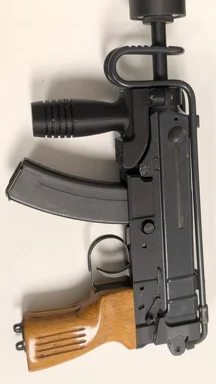
The VZ61 has always been a study in contrasts—compact enough to disappear under a coat, yet cursed with ergonomics that punish the shooter the moment the wire stock is deployed. This new foregrip design doesn’t just solve the thumb-bite problem; it reframes the entire platform as a legitimate SBR rather than a historical curiosity. By preserving the full travel of the folding stock while giving the support hand a repeatable, high-grip position, the part quietly removes one of the last practical objections to running the little Czech SMG in its most compact configuration. That matters because the VZ61’s aftermarket has long been starved for anything beyond magazine extensions and optic rails; a purpose-built interface that respects the original mechanism signals that even obscure imports can receive modern, user-driven upgrades without sacrificing their defining features.
What’s equally telling is the print specification itself: 50-plus percent infill and four walls on a part that lives directly above the bolt’s path. The maker isn’t treating this as a toy or a cosplay accessory; the hardware choice of two short M3 screws and the emphasis on density both telegraph an expectation that the grip will see real strings of fire. In an era when polymer printers sit on workbenches next to reloading presses, the line between “printable gadget” and “mission-critical furniture” is blurring fast. The 2A community has watched similar leaps with 3D-printed lowers, braces, and now fore-ends; each incremental success normalizes the idea that end users—not factories—decide what a firearm’s final form should be.
The larger implication is cultural as much as mechanical. When a shooter can download, iterate, and harden a solution for an imported, semi-auto-only VZ61 without waiting for a commercial vendor, the locus of innovation shifts from boardrooms to kitchen tables. That shift undercuts the familiar argument that “common use” is frozen at the moment of import or manufacture. Instead, common use becomes whatever the community can reliably produce and defend. A thumb-friendly foregrip on a wire-stocked SBR may look like a minor convenience, but it’s also a data point in an ongoing demonstration that the right to keep and bear arms includes the right to adapt those arms to the shooter’s actual needs.


