

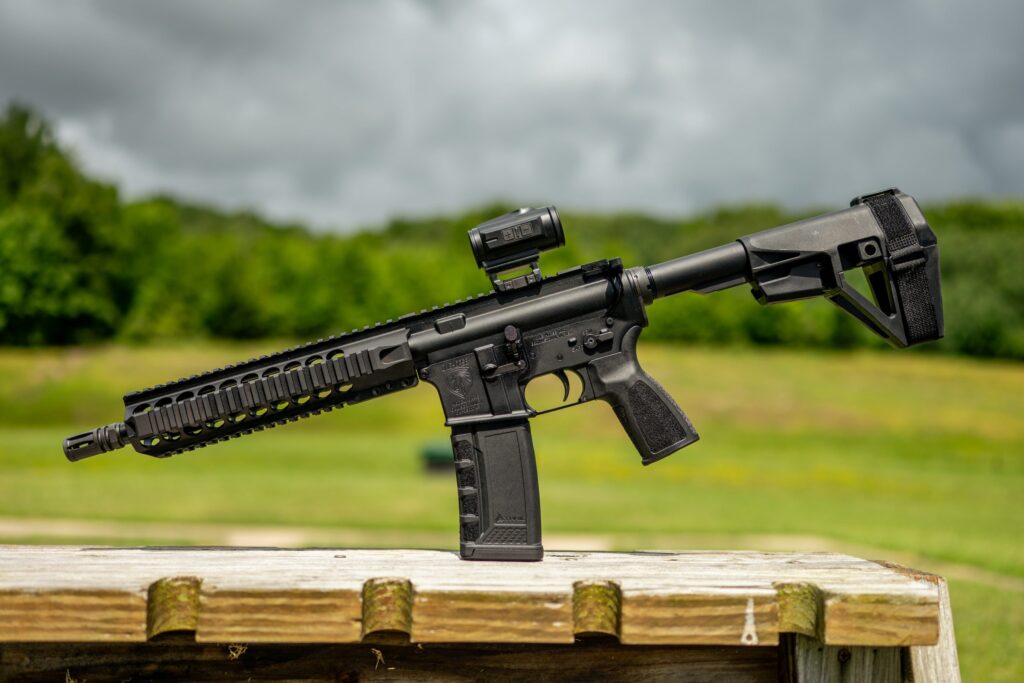
The One Horse Express pistol isn’t just another compact AR-9; it’s a deliberate middle finger to the notion that “forced-reset” technology belongs only in the hands of big manufacturers with deep legal teams. By pairing Atrius Development Group’s lightning-fast reset with a short-barreled, M-LOK or quad-rail chassis, the pistol collapses the gap between competition toy and truck-gun utility. Shooters who’ve grown tired of waiting on the reset of a mil-spec trigger now get race-gun cadence in a package that still fits under a jacket or behind a truck seat—without surrendering the modularity that made the AR platform king.
What makes this launch quietly revolutionary is how it weaponizes regulatory gray areas. Because the pistol is sold without a stock and the trigger is user-installed, the company sidesteps the pistol-brace rule, the “readily convertible” language around short-barreled rifles, and the still-unsettled definition of a “machine gun” under bump-stock precedent. That tightrope walk matters: every new configuration that survives an ATF letter or a court challenge expands the Overton window for what ordinary citizens can own. In an era when magazine capacity and semi-auto features are under constant siege, the Express pistol proves that mechanical innovation can still outrun bureaucratic inertia.
For the 2A community, the takeaway is twofold. First, support the small shops that treat the Second Amendment like an engineering spec instead of a marketing slogan; they’re the ones stress-testing the limits while the legacy brands play defense. Second, recognize that the next battle may not be over what you can own, but how fast you can shoot it. If forced-reset triggers become as common as red-dots, the practical difference between “semi-auto” and the mythical “assault weapon” shrinks to a trigger-housing swap—something no magazine ban or feature checklist can truly police.


