

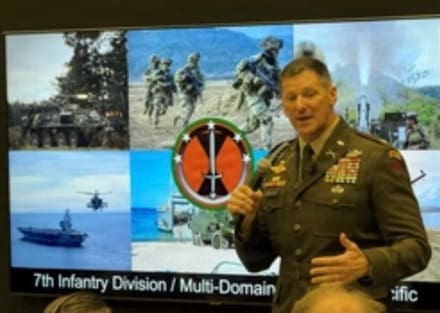
The Army’s decision to stand up Multi-Domain Command-Pacific is more than a bureaucratic reshuffle; it is a deliberate bet that future wars will be won or lost by the speed at which ground forces can orchestrate effects across every domain—land, sea, air, space, and cyber. By welding the 7th Infantry Division’s maneuver muscle to the 1st Multi-Domain Task Force’s long-range precision and electronic-warfare toolkit, the service is creating a single headquarters that can cue Navy missiles, Air Force bombers, and space-based sensors in real time. For the 2A community this matters because the same technologies that let a brigade commander call a hypersonic strike from 1,500 miles away also rely on resilient, distributed command networks that are hardened against jamming and cyber attack—networks that ultimately depend on the same small-arms and crew-served weapons that protect those nodes on the ground. In other words, the rifle in the hands of an infantryman is no longer just a last-ditch tool; it is the final link in a kill chain that stretches from orbit to the forward line of troops.
That linkage carries a second, subtler message for gun owners: the Army is openly acknowledging that massed formations are no longer survivable without organic, decentralized firepower. The experiment proved that a division-sized element can survive and fight only when every squad can contribute to the larger fight—whether by calling for artillery, launching loitering munitions, or simply holding terrain long enough for higher-echelon systems to reset. This is the same logic that underpins the civilian case for an armed populace: a free society that can field millions of trained, armed citizens creates a distributed sensor-and-response grid that no adversary can easily decapitate. MDC-PAC’s emphasis on “theater-enabling joint force integration” is therefore an implicit endorsement of the constitutional premise that the security of a free state rests on an armed citizenry capable of both local defense and national resilience.
Finally, the Pacific pivot underscores why the 2A community must stay engaged with emerging small-arms and optics technologies. The same lightweight, networked rifles, suppressors, and thermal sights that will let tomorrow’s soldiers stay lethal under contested electromagnetic conditions are already available to civilians. If the Army is betting its future on soldiers who can fight disaggregated yet remain lethal, then the legal and cultural defense of those same tools for private citizens is not a side issue—it is strategic insurance for the nation’s ability to project power from the inside out.


