

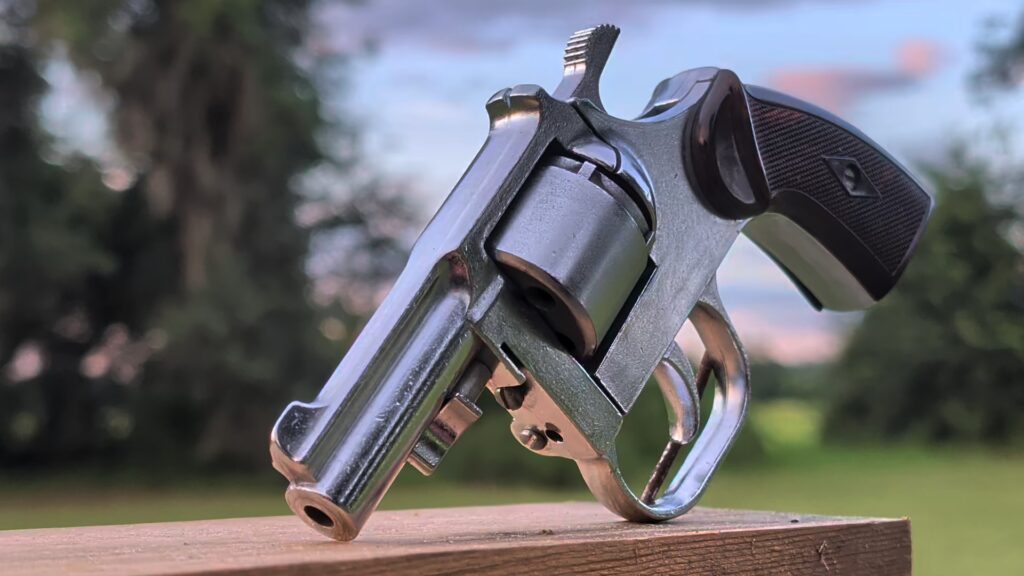
Clerke Technicorp, a California firm spun off from knife importer EIG Cutlery, began making the Clerke First revolver after the 1968 Gun Control Act used a point system of barrel length, weight, caliber and sights to stop cheap foreign handguns from entering the country. Remaining demand for inexpensive revolvers led the company to sell its models for 15 to 25 dollars in the 1970s, using starter-pistol tooling and also offering a blank-firing version.
Construction relied mainly on zinc alloy, with a steel barrel liner under a thick outer coating that made a .22 Long Rifle snub-nose example weigh about one pound. Fixed sights formed part of the frame, the firing pin rode on the hammer, and the cylinder swung out only after a front pin was pulled; that same pin then punched out spent cases because no ejector was fitted. The design appeared in .22 Long Rifle and .32 S&W, though the examined .22 specimen held five chambers rather than the six often cited.


