

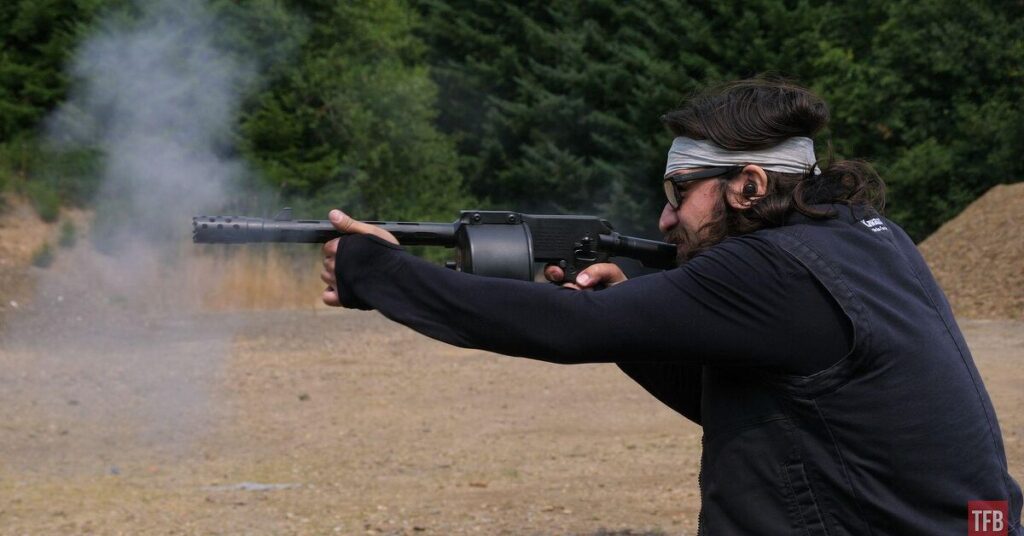
The Armsel Striker—better known stateside as the Street Sweeper—has always occupied that peculiar corner of the gun world where mechanical curiosity collides with political mythology. Designed in South Africa during the height of the apartheid-era unrest, the twelve-shot, 12-gauge rotary shotgun was marketed as a tool for “crowd control,” yet its very existence became Exhibit A in the 1994 federal assault-weapons debate. When the Clinton-era Crime Bill slapped it with a ten-thousand-dollar tax stamp and a barrel-length requirement that effectively banned importation, the Striker morphed from oddity to totem: proof, depending on whom you ask, that Washington fears armed citizens more than it fears armed criminals. Watching one cycle through a cylinder at the range is less about ballistic performance and more about witnessing a living artifact of that legislative panic.
What makes the gun fascinating isn’t its dubious ergonomics or the thumb-breaking bolt handle; it’s the way it forces a conversation about purpose versus perception. In the hands of a private citizen at a rural berm, the Striker is simply an expensive, finicky scattergun whose drum magazine offers more theater than practical advantage over a standard pump or semi-auto. Yet the same firearm, had it stayed in police or military inventories, would have been hailed as an innovative less-lethal platform. That double standard is the real story. It underscores how the 2A community’s fight is often less about hardware and more about narrative—who gets to own what, and why one group’s “tool” is another’s “threat.”
For enthusiasts, the Striker’s rarity has turned it into rolling proof that prohibition rarely extinguishes interest; it merely prices oddities beyond most citizens and drives innovation underground or overseas. Every time a fresh cylinder rotates into battery with that distinctive clockwork clack, it reminds shooters that the right to keep and bear arms isn’t static. It’s a moving target, constantly redefined by regulators who mistake mechanical novelty for societal danger, and by owners who treat each new restriction as fresh incentive to collect, restore, and—when legal—shoot the very guns the law tried to disappear.


