

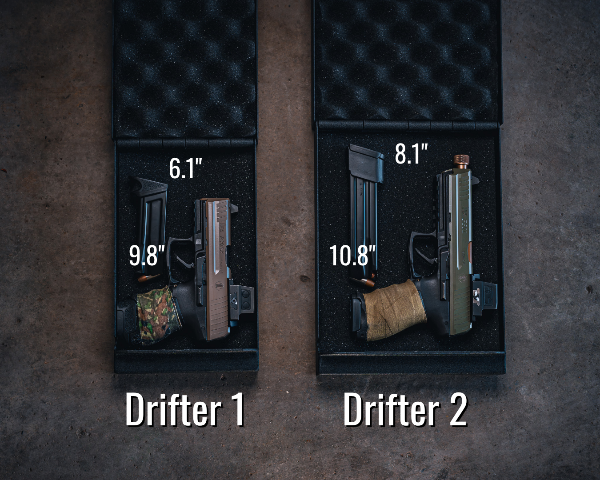
Steelhead Outdoors has quietly stepped into a space that too many manufacturers ignore: the need for secure storage that actually fits the pistols most duty-minded Americans now carry. By designing lockers and lockboxes around the reality of weapon-mounted lights, red-dot optics, and suppressor-height sights, the Minnesota-based company is acknowledging that the modern defensive handgun is no longer a slim 1911 or a bare-bones Glock 19. Their stackable vertical and horizontal units, along with portable lockboxes and security cables, all built in Shakopee, give owners a way to keep loaded, optics-ready firearms both accessible and compliant with storage laws without having to strip accessories every time they come home. For the 2A community this matters because storage mandates are expanding in blue states and cities; if the only “legal” option forces you to remove your light or optic, the practical effect is a restriction on the very configurations that improve accuracy and low-light performance.
What makes the move noteworthy is the explicit American manufacturing claim at a moment when supply-chain fragility and geopolitical risk have pushed many gun owners to prioritize domestic production. Charlie Pehrson and Corey Meyer aren’t just selling another generic safe; they’re betting that a growing segment of the market will pay a premium for lockers sized for today’s duty guns and stamped “Made in Minnesota.” That decision ripples outward: it supports skilled trades in the heartland, shortens lead times compared with overseas competitors, and insulates buyers from tariff or shipping shocks. More importantly, it reframes the storage conversation from a grudging compliance exercise into an affirmation that responsible ownership includes both readiness and security—an argument the community can carry into legislative debates where anti-gun voices try to portray any storage requirement as an existential threat rather than a solvable engineering problem.
The broader implication is cultural as much as practical. By normalizing secure storage that respects the way people actually equip their firearms, Steelhead is helping close the rhetorical gap between “gun owner” and “safe gun owner.” When products like these become commonplace in gun shops and on range rental counters, the image of the armed citizen shifts from the cartoonish “gun lying on the kitchen table” to one of deliberate, layered responsibility. That shift matters in courtrooms, in media narratives, and at the ballot box, because it undercuts the claim that expanded background checks or storage rules must inevitably disarm lawful carriers. In short, Steelhead’s lockers are small hardware with outsized signaling value: they prove that American industry can meet both the tactical demands of modern pistols and the political demands of a rights-conscious public without forcing a compromise on either front.


