

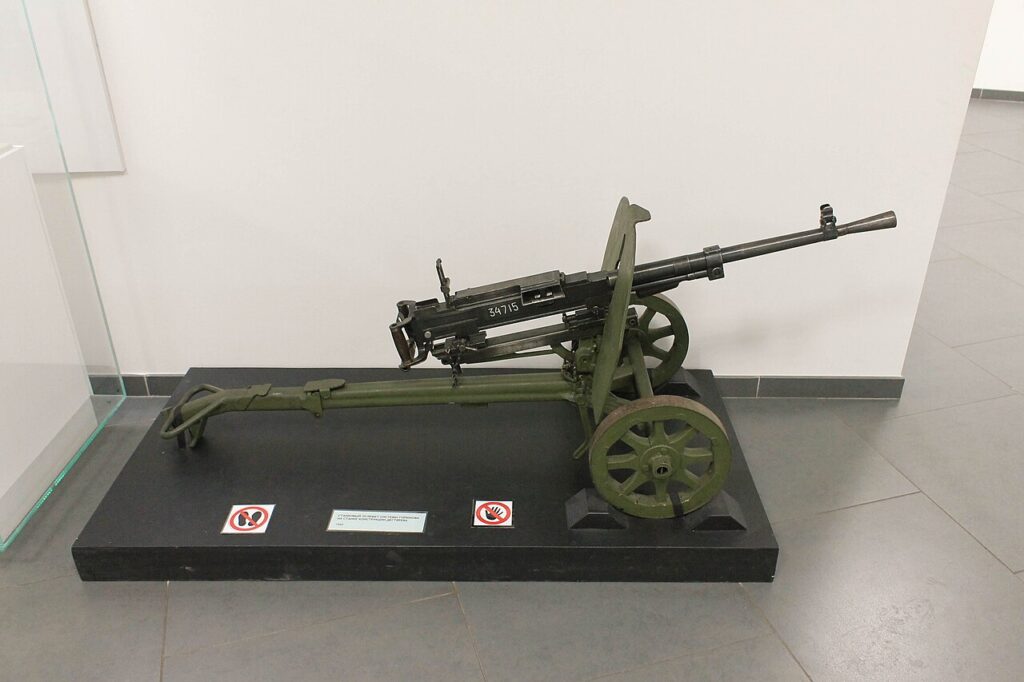
The SG-43 Goryunov arrived in 1943 as the Red Army’s answer to the Maxim’s water-jacketed bulk, swapping a heavy, coolant-dependent design for a simpler, air-cooled weapon that could be dragged across frozen mud or bolted to the side of a T-34. Its sideways-tilting bolt and two-claw feed system look needlessly intricate on paper, yet the mechanism proved brutally dependable; the same cartridge that had to be yanked backward out of a non-disintegrating belt before being shoved forward again rarely caused stoppages, a lesson in over-engineering that still echoes whenever American shooters debate whether “simpler is always better.”
For the 2A community the Goryunov is a living rebuttal to the notion that only semi-automatic, detachable-magazine arms matter. Here was a belt-fed, crew-served machine gun rushed into production under existential pressure, then refined by armorers who understood that reliability under mud and neglect outweighed theoretical elegance. Collectors who track transferable Maxims or post-sample PKMs recognize the SG-43’s DNA in later Warsaw-Pact derivatives, reminding us that the right to keep and bear arms historically included the tools of collective defense, not merely individual self-defense.
Today the gun survives in private hands as a curio and relic, its 7.62×54R chambering still fed by the same non-disintegrating belts that once rattled across the Eastern Front. Every time an SG-43 cycles at a machine-gun shoot, it underscores a deeper principle: the Second Amendment’s strength lies not in restricting citizens to “sporting” arms, but in preserving the continuum of firearms technology—from militia muskets to belt-fed workhorses—so that the people remain, in Madison’s phrase, “properly armed and equipped.”


