

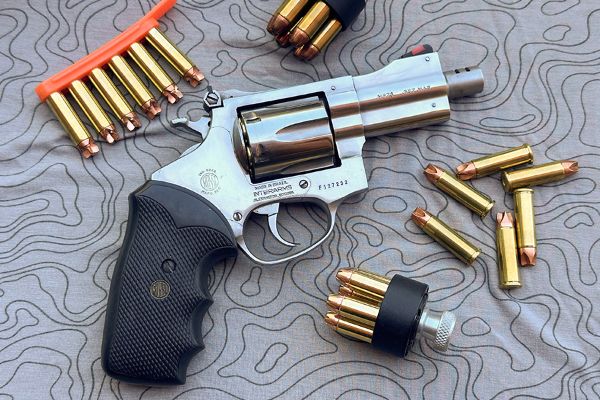
Travel back to an era when revolvers ruled the gun shop counters and the only surveillance came from the watchful eye of the shop owner, and you’ll find the Rossi M971 .357 Magnum sitting right alongside the Colts and Smith & Wessons that defined an entire generation of wheelgun enthusiasts. This Brazilian-made six-shooter wasn’t trying to out-glitz the big American names; it simply delivered a solid, affordable DA/SA .357 that let working folks carry the same cartridge power as a Model 19 without mortgaging the house. In a market where Colt versus S&W arguments could turn a Saturday afternoon into a full-contact debate, the M971 quietly proved that solid lockup, smooth double-action pull, and genuine Magnum capability didn’t have to cost a month’s wages—something today’s polymer-frame crowd sometimes forgets when they dismiss anything without a rail or an optic cut.
That accessibility mattered then and still matters now. While today’s 2A debates often center on magazine capacity and red-dot pistol optics, the M971 reminds us that the right to keep and bear arms has always included the freedom to choose practical tools that fit real budgets and real lives. Its existence in the pre-internet age underscored a deeper truth: when quality revolvers were plentiful and competition was fierce, innovation wasn’t limited to high-end marques; importers and smaller makers kept the market honest by offering capable alternatives that expanded ownership rather than restricting it to those who could afford premium pricing. For today’s carriers who value simplicity, durability, and the unmistakable authority of a .357, the M971 stands as living proof that the Second Amendment isn’t just about the newest striker-fired wonder; it’s also about preserving the mechanical diversity that lets every lawful citizen find a firearm that actually fits their hand and their mission.
In an age of ever-tightening regulations and corporate consolidation, the Rossi’s story carries an implicit warning and an implicit promise. The warning is that once choice narrows—whether through import bans, boutique pricing, or cultural pressure to abandon “old tech”—the practical exercise of the right to bear arms shrinks along with it. The promise is that affordable, capable wheelguns like the M971 keep that right tangible for the next generation of shooters who may one day stand in a gun shop and argue, not over pixels and ergonomics, but over the timeless virtues of steel, timing, and six honest rounds.


