

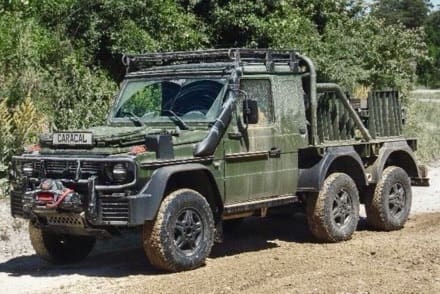
Rheinmetall’s new Caracal 6×6 isn’t just another military truck—it’s a rolling reminder that the same engineering principles that keep airborne troops light, lethal, and logistically nimble also underpin the civilian firearms market’s obsession with modularity and rapid deployment. By stretching the proven Caracal air-drop chassis into a six-wheeled configuration, the German firm has created a platform that can be slung under a CH-47, parachuted into contested airspace, then reconfigured on the ground with mission pods ranging from command-and-control to casualty evacuation. That same “plug-and-fight” DNA shows up every time an American gun owner swaps an AR upper, mounts an LPVO, or drops a suppressor on a pistol brace; the hardware is designed from day one to be broken down, moved fast, and rebuilt for the fight at hand.
For the 2A community the takeaway is straightforward: when governments invest in lightweight, high-mobility systems that can be owned and operated by small teams, they validate the very attributes that make privately held firearms a credible check on centralized power. A six-wheeled vehicle that fits inside a C-130 or rides under a helicopter proves that strategic reach no longer requires a division’s worth of heavy armor; likewise, a compact, optics-ready rifle proves that individual citizens can project accurate, effective force without waiting for a government convoy. Rheinmetall’s timing—unveiling the rig at Eurosatory while NATO members openly discuss rapid-reaction forces—signals that Western militaries are doubling down on dispersed, air-mobile units rather than massed tank columns. That doctrinal shift quietly reinforces the argument that an armed populace equipped with modern, modular firearms is not an anachronism but a logical extension of the same mobility-first mindset now driving billion-euro defense contracts.
The deeper implication is cultural as much as tactical. Every time a defense contractor markets “maximum operational flexibility,” it normalizes the idea that citizens, not just states, should be able to tailor their tools to the threat of the moment. Whether that tool is a 6×6 that transforms from gun truck to ambulance in minutes or a semi-auto rifle whose rail system accepts everything from a 1-6× optic to a 40 mm launcher, the principle is identical: ownership of adaptable technology preserves options when the balloon goes up. Rheinmetall may be selling to armies, but the intellectual property on display—light, lethal, reconfigurable—belongs just as much to the individual gun owner who refuses to be outpaced by the state’s latest mobility platform.


