

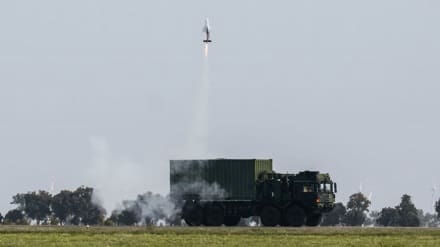
Rheinmetall’s successful launch of the FV-014 loitering munition from its Containerized Missile Launcher is more than a technical milestone—it’s a vivid reminder that the same engineering principles that let a private company pack precision-guided firepower into a shipping container are the very principles that keep civilian firearms legal, accessible, and constantly improving. The demonstration shows how quickly a modular launcher can be reconfigured for different munitions, a concept that mirrors the aftermarket ecosystem of AR-15s, 1911s, and bolt-actions where one serialized receiver can host an almost infinite array of barrels, optics, and triggers. In both worlds, the underlying technology is dual-use: the same CNC tolerances, materials science, and software interfaces that let a defense contractor swap warheads in minutes also let a hobbyist swap barrels at the range without filing paperwork.
For the 2A community, the takeaway is strategic rather than tactical. When a NATO-tier firm proves that loitering munitions can be stored, transported, and launched from something as ubiquitous as a commercial shipping container, it undercuts the narrative that only standing armies can field “advanced” weapons. That same logic applies at home: if a container on a flatbed can become a missile battery, then a gun safe in a citizen’s closet remains a legitimate instrument of individual and community defense. The demonstration also highlights the speed of innovation—Rheinmetall went from concept to live-fire in roughly the time it takes most states to pass a single gun-control bill—reminding us that rights depend on technological agility as much as on legislation.
Finally, the FV-014’s containerized launch foreshadows a future where precision munitions could migrate from the battlefield to the homestead in the same way night-vision, laser aiming modules, and now smart optics have already done. The 2A community’s long-standing argument—that an armed populace is a deterrent to tyranny—gains empirical weight every time private industry miniaturizes and modularizes weapons that once required an entire logistics tail. Rheinmetall didn’t set out to validate the Second Amendment, but its engineers just handed the grassroots another data point: the tools of decisive force are becoming smaller, cheaper, and more adaptable, and they’re doing it in full view of civilian markets that prize the same qualities.


