

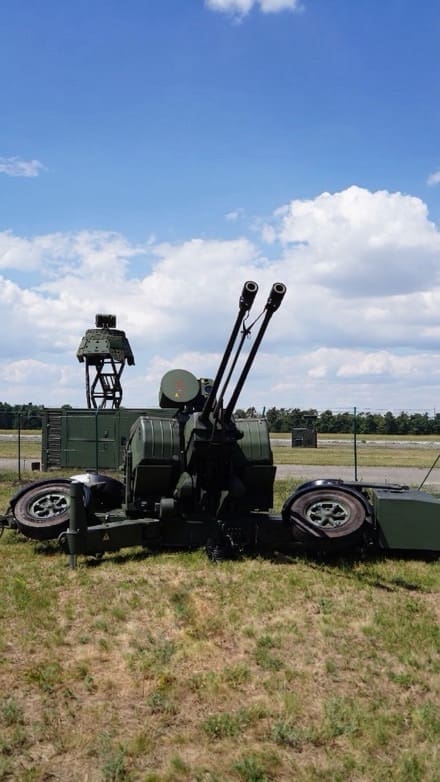
Rheinmetall and Hensoldt just proved that the future of air defense isn’t about bigger radars—it’s about smarter, quieter ones. By folding Hensoldt’s Twinvis passive radar into Rheinmetall’s Skymaster command system during the German Air Force’s Timber Express 2026 exercise, the two companies showed how a network of sensors can build a complete air picture without ever emitting a single detectable pulse. That matters because passive detection is almost impossible to jam or spoof, and it leaves the defender’s own location hidden from enemy anti-radiation missiles. For the Second Amendment community, the lesson is straightforward: the same principle that protects a nation’s skies—distributed, low-signature sensing—also protects an individual’s right to keep and bear arms. When every sensor node can contribute without revealing itself, the network becomes resilient; when every armed citizen can contribute without being singled out, liberty becomes resilient too.
The technical payoff is equally instructive. Skynex, Rheinmetall’s gun-based close-in defense system, now receives targeting cues from a radar that an adversary literally cannot “see” on the electromagnetic spectrum. That means gun layers get accurate tracks on drones, cruise missiles, and low-observable aircraft while the enemy is still trying to figure out where the data is coming from. Translate that to the domestic arena and you have a model for decentralized deterrence: millions of lawfully armed citizens, each acting as an independent sensor in a constitutional network that no single point of failure—regulatory or technological—can shut down. The Germans are learning that passive integration multiplies capability without multiplying signature; Americans already know that an armed populace multiplies security without multiplying tyranny.
What happens next will test whether Western procurement bureaucracies can move as fast as the technology. If Skymaster-style fusion software can stitch together everything from reconfigurable howitzers to commercial drone detectors, the same open architecture could let civilian rifle clubs, volunteer fire departments, and county sheriffs share real-time situational awareness without creating a centralized database that begs for abuse. In both domains—air defense and individual rights—the winners will be those who treat information as a weapon that can be shared without being surrendered. Rheinmetall and Hensoldt just gave the world a live-fire demonstration; the 2A community should take notes and start building its own passive, distributed, and therefore unstoppable network.


