

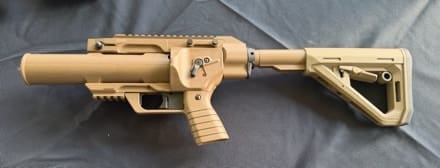
Colt Canada’s fresh C27 40 mm grenade launcher isn’t just another incremental upgrade; it’s a deliberate pivot toward modularity that quietly rewrites how small units can project explosive power without waiting for dedicated mortar teams. By swapping the aging M203’s under-barrel lock-up for a side-opening breech and double-action trigger, the Canadians have created a stand-alone launcher that still clamps to any Picatinny rail via captured pins and recoil lugs—meaning the same receiver can ride solo with a stock and optic or ride shotgun beneath a C7 or C8. That flexibility matters in an era when patrol sizes shrink and every rifleman may need to become a grenadier on short notice.
For the broader 2A community the C27’s arrival is a reminder that innovation in small-arms lethality isn’t limited to the civilian market; it’s a live demonstration of how quickly a modern military can field a true multi-role 40 mm system once political will and industrial capacity align. While American civilians remain locked out of 40 mm high-explosive rounds by the Hughes Amendment and the NFA’s $200 tax stamp on destructive devices, the C27’s existence underscores the technological gap that keeps widening between what our armed forces can field and what law-abiding citizens are permitted to own. The launcher’s limited-service debut with Canadian troops also hints at future aftermarket or export possibilities—perhaps a semi-auto, less-lethal variant or a dedicated stand-alone chassis—that could eventually influence stateside debates over easing restrictions on smooth-bore 40 mm launchers for sporting or defensive use.
In short, the C27 is more than a replacement for the M203; it’s a case study in how a single, well-engineered receiver can multiply a squad’s options while simultaneously spotlighting the artificial legal ceilings that still cap American civilian access to the same class of equipment. As Canada quietly modernizes its grenadier capability, the U.S. 2A community is left watching from the sidelines, armed with the knowledge that the hardware exists and the only real barrier left is political.


