

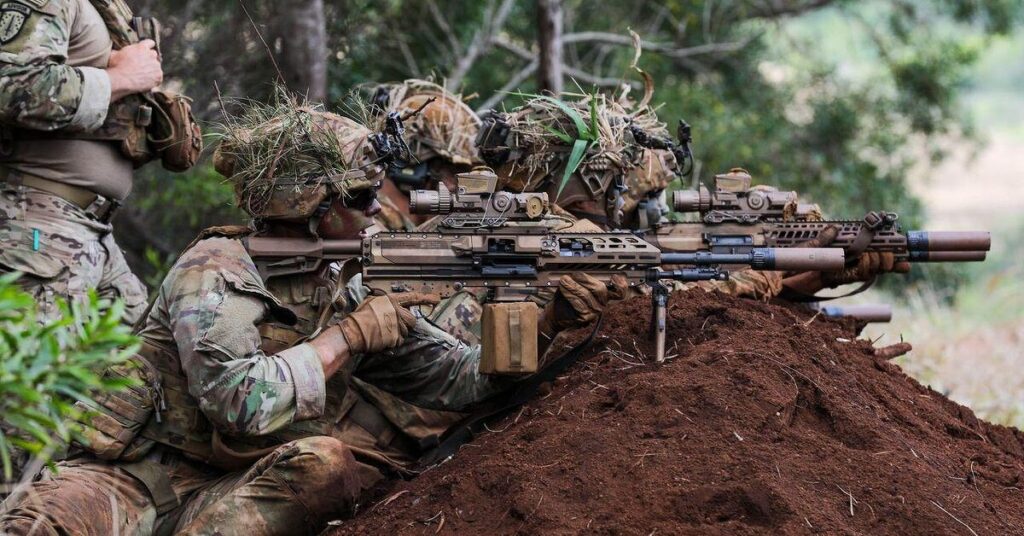
The Army’s decision to run the M7 rifle, M250 automatic rifle, and M157 optic through the punishing environment around Schofield Barracks isn’t just another field exercise—it’s a real-world stress test that matters to every civilian who values reliable tools. Hawaii’s combination of salt-laden air, constant moisture, and thick vegetation accelerates corrosion and fouling in ways that most ranges never replicate, so when the 25th Infantry Division reports back on how these weapons hold zero, cycle under heavy fouling, and survive repeated exposure, the data will either validate or expose the design choices made during the NGSW program. For the 2A community this matters because the same companies producing these rifles for Uncle Sam also sell semi-automatic versions to the public; if the M7’s hybrid case and higher-pressure cartridge prove fragile in the jungle, that weakness will eventually appear in the commercial market, and if they thrive, it strengthens the argument that modern manufacturing and materials can deliver lighter, harder-hitting options without sacrificing durability.
Beyond the hardware itself, the test highlights a deeper tension between bureaucratic procurement and the practical demands of individual marksmanship. The 25th ID’s “Tropic Lightning” soldiers are essentially serving as unpaid R&D for a system that will eventually influence what civilians can own, yet the same regulatory environment that green-lights these trials continues to restrict the very features—quick-detach suppressors, short barrels, and high-capacity magazines—that make the rifles effective in dense terrain. When the after-action reports eventually surface, expect the usual spin about “lessons learned,” but the underlying takeaway for gun owners is that government testing rarely captures the full spectrum of civilian use cases; private citizens in humid states or coastal regions will still need aftermarket coatings, sealed optics, and rigorous maintenance routines that the Army’s logistics tail can’t always provide.
Ultimately, the Schofield trial is a reminder that rights are defended not just in courtrooms but in the dirt, salt, and rain where weapons either work or they don’t. If the M7 family survives Hawaii’s crucible, it bolsters the case that American innovation can meet real-world threats without relying on outdated platforms; if it falters, it hands critics another data point to claim civilians don’t need such “military-grade” firearms. Either outcome feeds directly into the ongoing debate over what technology the people may keep, and the 2A community would do well to watch the results as closely as any congressional hearing.


