

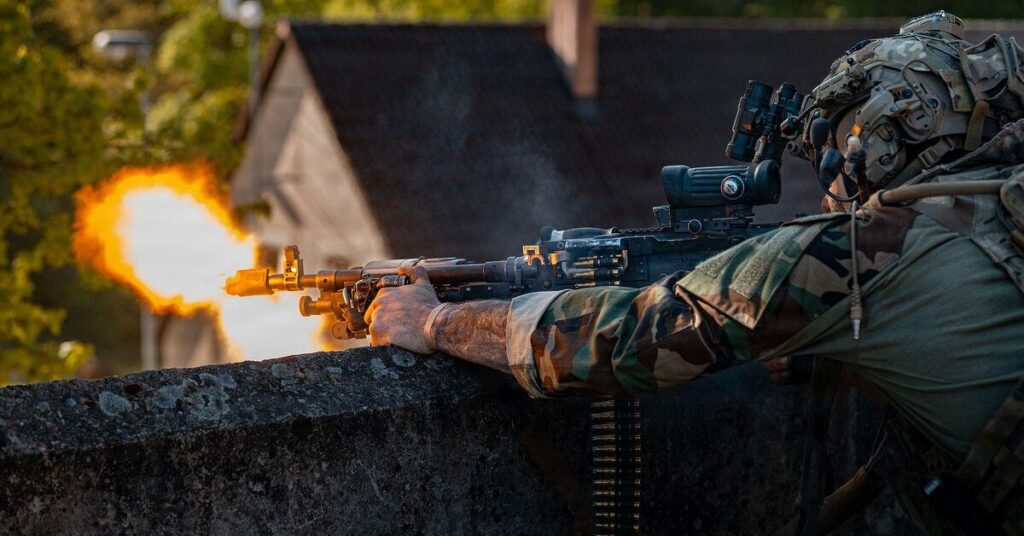
In the rolling hills of Hohenfels, Germany, the 7th Army Training Command just finished a month-long crucible that put 3,600 troops from seven nations through the kind of friction that only combined-arms, multi-domain warfare can generate. What looked like another NATO training rotation was actually a live demonstration of why the Second Amendment remains the ultimate backstop for free societies: when professional armies rehearse fighting peer adversaries, they are also rehearsing the skills that keep authoritarian regimes from ever testing the resolve of armed citizenries. The interoperability drills—linking U.S. armor with Polish artillery, German logistics, and Romanian cyber teams—highlight how quickly modern battlefields reward nations that maintain both a professional force and a population comfortable with the tools of war.
For the 2A community, the takeaway is straightforward: the same small-arms and crew-served weapons that NATO units are stress-testing in Hohenfels are the direct descendants of the rifles and carbines civilians can still own in the United States. Every after-action review that praises quick magazine changes, reliable optics, and modular rail systems is quietly validating the very features anti-Second Amendment voices want to restrict. When the exercise ends and the troops return home, the lessons don’t vanish; they filter into reserve and National Guard units, many of whose members are also private citizens who train with essentially the same platforms on the weekend. That overlap keeps institutional knowledge alive in the body politic rather than locked inside a standing army that could one day be turned against it.
The deeper implication is strategic. Authoritarian states betting that Western publics have grown too soft or too regulated to resist see these rotations and recalculate. A population that can already handle an AR-15 or an M4-pattern rifle, that already understands zeroing, malfunction clearance, and small-unit tactics, shortens the timeline between “invasion map” and “sustained partisan resistance.” Combined Resolve 26-07 didn’t just sharpen NATO’s edge; it quietly reminded the world that the right to keep and bear arms is not a hobby—it is the distributed, deniable reserve that makes large-scale aggression against free nations prohibitively expensive.


