

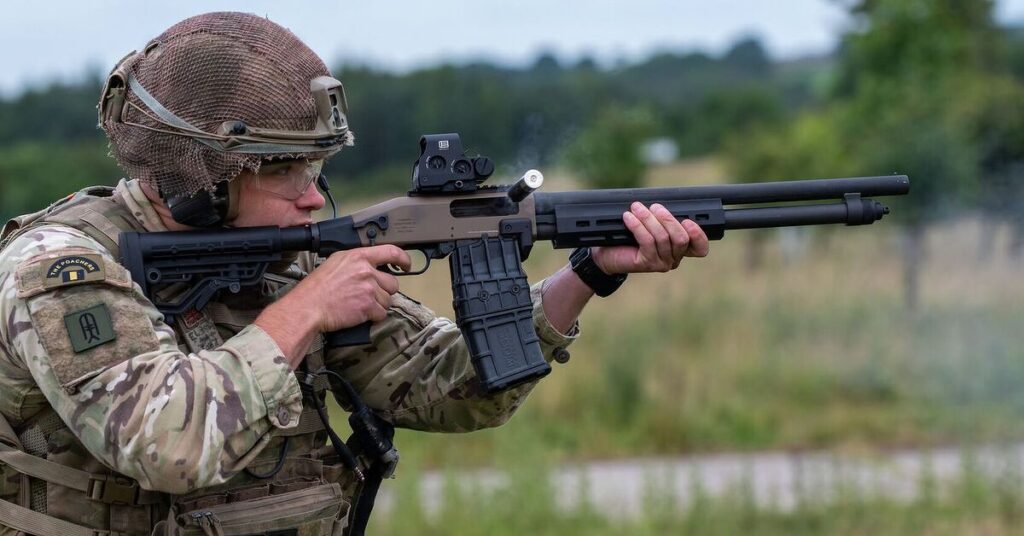
The British Army’s decision to trial the Mossberg 590M—now stamped L351A1—against small drones is a reminder that the shotgun’s utility has never been confined to clay targets or home defense. By mating a high-capacity, box-fed 12-gauge to a proven pump-action chassis, the 590M gives dismounted troops a magazine-fed, shoulder-fired answer to the low-and-slow threat that has bedeviled infantry since the first quadcopter dropped a grenade. In an era when electronic warfare jammers and expensive MANPADS are often unavailable at the squad level, a simple scattergun loaded with tungsten fléchette or #2 steel suddenly becomes the last-ditch “kill switch” for a $500 drone that can still kill soldiers.
For American gun owners the lesson is straightforward: the same features that make the 590M attractive to the British Army—quick-detach magazines, optics-ready receivers, and the ability to chamber everything from 00 buck to specialized anti-drone loads—are precisely the attributes that anti-gun legislators want to restrict here at home. Every time a foreign military validates the tactical relevance of magazine-fed shotguns, it undercuts the narrative that such firearms are “unnecessary for civilians.” The 2A community should treat the L351A1 trial not as an oddity, but as live-fire proof that the modern defensive shotgun remains a legitimate tool for both soldier and citizen.
Finally, the experiment underscores how quickly small-arms doctrine can pivot when the threat changes. If a NATO partner is willing to resurrect the pump-gun for counter-UAS work, American owners should feel equally justified in keeping magazine-fed scatterguns in the inventory for everything from rural property defense to disaster-response scenarios where drones may be the only airborne eyes in the sky. Rights rarely expand by accident; they expand when citizens demonstrate the same practical utility that governments quietly adopt for themselves.


