

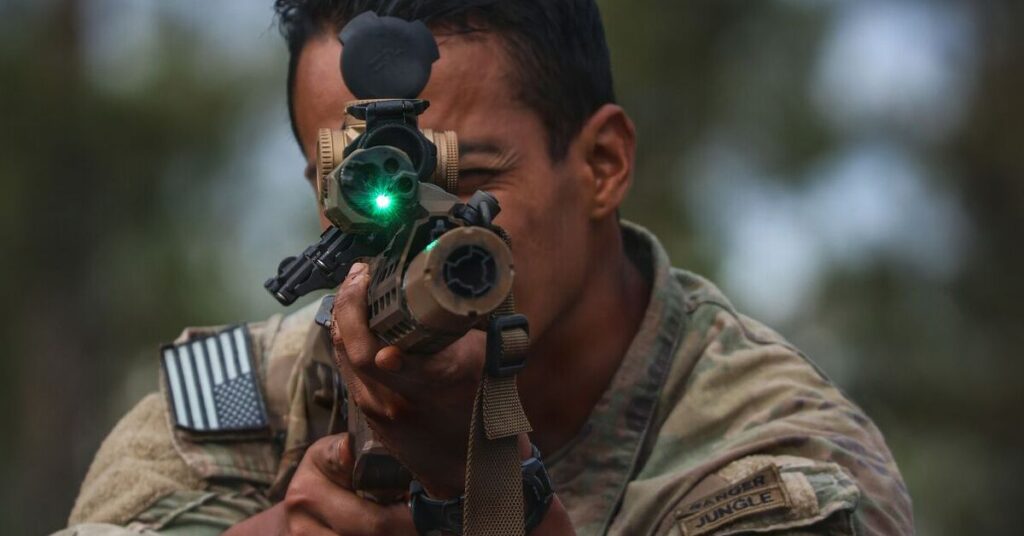
The Army’s decision to push the M7 rifle and its 6.8×51mm cartridge into the hands of 2nd Battalion, 21st Infantry Regiment in the Pacific isn’t just another equipment swap—it’s a deliberate signal that the service is prioritizing lethality over legacy logistics. By moving the Next Generation Squad Weapon out of test units and into a line battalion already forward-deployed, the Army is betting that the heavier, higher-velocity round will give small teams a decisive edge against body-armor-equipped adversaries at ranges where the 5.56 has long been marginal. For the 2A community, the optics are unmistakable: the same government that spent decades telling civilians that “military-grade” 5.56 was sufficient for home defense is now admitting, through its own procurement, that a more powerful cartridge is necessary for real-world threats.
That admission carries downstream consequences for civilian access and innovation. The 6.8×51mm cartridge was developed under a government contract that bypassed many of the usual bureaucratic hurdles; once the round is in full-rate production, commercial variants will inevitably follow, giving reloaders and precision shooters access to a cartridge that outperforms both 5.56 and 7.62 NATO in the intermediate range. At the same time, the M7’s modular design—quick-change barrels, improved suppressors, and advanced fire-control optics—sets a new baseline that aftermarket manufacturers will race to meet. The result is likely to be a wave of civilian-legal rifles chambered in 6.8×51 or its commercial offspring, further eroding the notion that only the military needs “battlefield” performance.
Critics inside the gun-control lobby will almost certainly use the M7’s rollout to argue for renewed restrictions on “military-style” weapons, yet the very existence of the NGSW program undercuts their premise. If the Army requires a more powerful round and a more ergonomic platform to stay ahead of near-peer threats, then the same logic applies to law-abiding citizens who face increasingly armed criminal elements. The Pacific deployment of the M7 is therefore more than a tactical update; it is fresh evidence that the Second Amendment’s protection of arms “in common use” for lawful purposes must evolve with battlefield realities, not be frozen by 20th-century assumptions about what constitutes an adequate defensive firearm.


