

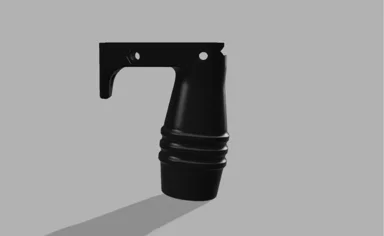
The Picatinny rail bulb grip ribbed design represents a clever evolution in the ongoing arms race between 3D-printed accessories and the regulatory gray areas that surround them. By integrating a forward-angled bulb profile with a built-in handstop, the model solves two classic problems at once: it gives the shooter a repeatable index point for consistent hand placement, and it does so without requiring a separate accessory or additional hardware. The print instructions—upside-down orientation, auto-supports, and near-solid infill—aren’t just technical trivia; they’re a tacit acknowledgment that the part must survive real-world abuse while remaining light enough to keep the rifle’s balance neutral. In an era when the ATF’s shifting definitions of “pistol brace” and “vertical foregrip” keep manufacturers guessing, this kind of open-source geometry becomes both a workaround and a statement: if the government can’t decide what counts as a grip, the community will simply print its own.
Beyond the ergonomics, the file’s LBRY tags—guncad, ar15, grip, picatinny—signal a broader cultural shift. What used to be a niche hobbyist pursuit is now a distributed R&D network that moves faster than any corporate product cycle. Each iteration uploaded to the ledger is effectively peer-reviewed by thousands of users who can remix, reinforce, or refute the design within days. That speed matters when the political climate can flip overnight; a grip that’s perfectly legal in one state can become contraband in another with a single court ruling. By keeping the source files decentralized and the manufacturing local, the 2A community hedges against both regulatory capture and supply-chain fragility. The bulb grip ribbed isn’t just a piece of plastic—it’s a data point in an argument that the right to keep and bear arms includes the right to design, iterate, and share the tools that make those arms usable.


