

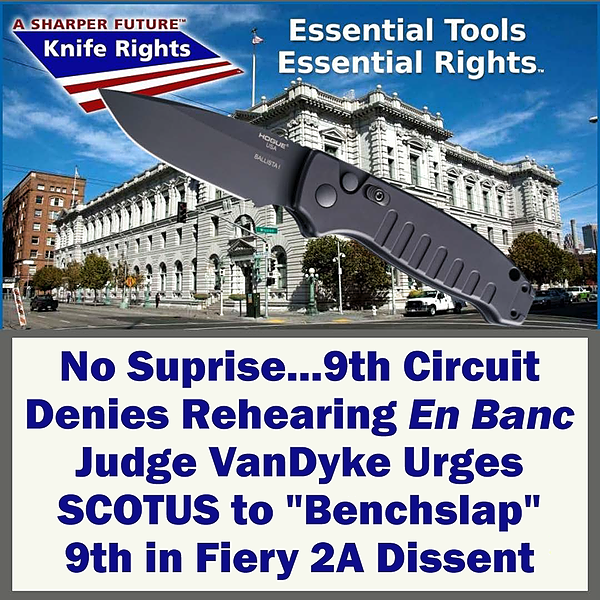
The Ninth Circuit’s refusal to rehear the California switchblade case en banc is more than a procedural footnote—it’s a flashing warning light that the lower courts still haven’t internalized Bruen’s command to stop inventing “sensitive places” and “sensitive objects” out of thin air. Eight judges signed on to dissents that read like a brief for the Supreme Court, calling out the panel for treating a folding knife the same way earlier courts once treated handguns: as something that can be banned simply because it’s scary or “unusual.” That kind of reasoning collapsed after Heller and Bruen; the fact that it’s still alive in the Ninth Circuit tells you how much work remains before the right to keep and bear arms is treated like any other enumerated right.
What makes the dissents especially sharp is their refusal to play the usual game of pretending switchblades are some exotic modern danger rather than tools that have existed for generations. The judges correctly note that California’s ban sweeps in ordinary pocketknives millions of law-abiding citizens carry daily, and that the state offered no historical analogue from the Founding era or Reconstruction that would justify disarming people for choosing a one-handed opening mechanism. This isn’t about “assault knives”; it’s about whether the government gets to decide which constitutionally protected arms are too efficient for civilians to own—an argument that would have sounded ridiculous if applied to semiautomatic pistols or repeating rifles.
For the broader Second Amendment community the takeaway is straightforward: the Ninth Circuit has once again shown it will keep kicking the can until the Supreme Court forces the issue. Knife Rights’ potential cert petition is therefore more than a tactical move; it’s a chance to lock in the principle that the right to bear arms includes the right to bear the arms people actually use, not just the ones judges find aesthetically pleasing. If the Court takes the case, expect a ruling that either slams the door on these lingering “dangerous and unusual” loopholes or leaves the circuit split to fester—either way, the days of treating knives as second-class arms are numbered.


