

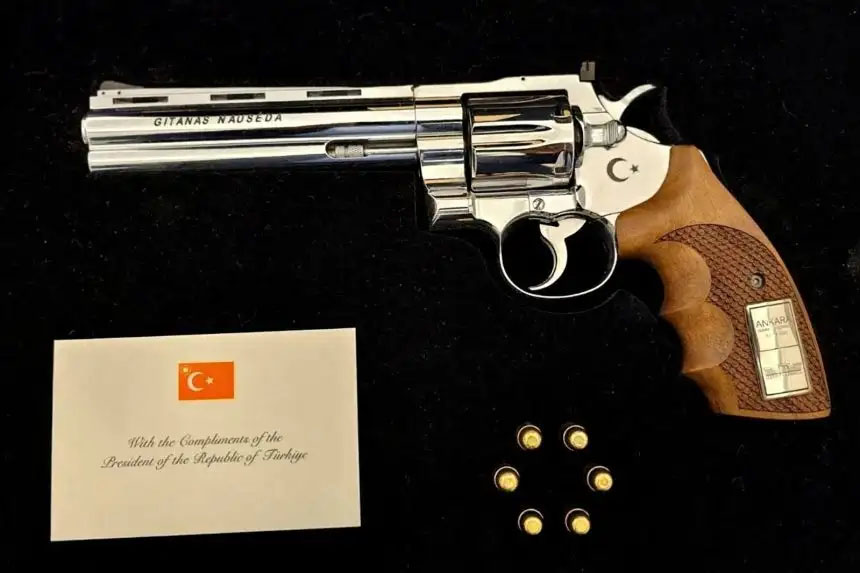
When Turkish President Erdogan handed out custom Gumusay .357 Magnum revolvers to visiting NATO heads of state, the gesture was less about personal defense and more about reminding every recipient that Turkey still manufactures its own steel. The six-shot wheelguns—Turkish clones of the classic Python frame—carry the unmistakable message that Ankara can arm itself without waiting on European or American export licenses. For the 2A community, the optics are delicious: while Western capitals debate magazine limits and “assault weapon” bans, a NATO ally is proudly exporting large-frame revolvers chambered in a cartridge that many U.S. states still treat as unremarkable. The symbolism lands harder than the recoil; it underscores how firearm culture remains a live strategic asset rather than a quaint hobby confined to American gun shows.
The real story isn’t the gift itself but the quiet industrial capacity behind it. Gumusay’s ability to reverse-engineer and domestically produce a service-grade .357 suggests Turkey has closed the loop on metallurgy, heat treating, and precision machining—skills that translate directly into small-arms self-sufficiency. That autonomy gives Ankara leverage inside the Alliance: if Brussels ever tries to condition arms sales on political concessions, Turkey can point to its own revolver lines and shrug. Meanwhile, American gun owners watching the spectacle are reminded that rights without an industrial base are just talking points; the same politicians who lecture about “common-sense gun safety” abroad often ignore how fragile our own domestic manufacturing ecosystem has become after decades of regulatory pressure and offshoring.
For Second Amendment advocates, the Ankara revolver story is a teachable moment in deterrence theory. A nation that can hand its allies handguns instead of asking for them is harder to coerce. The same principle scales down to the individual: an armed citizenry with access to quality firearms and the legal infrastructure to keep them is far less susceptible to soft authoritarianism than one that must beg permission slips from the state. As NATO grapples with energy dependence, migration policy, and Article 5 credibility, the image of world leaders awkwardly accepting Turkish wheelguns serves as a reminder that sovereignty still rests, in part, on who controls the tools of force—and who is willing to keep making them.


