

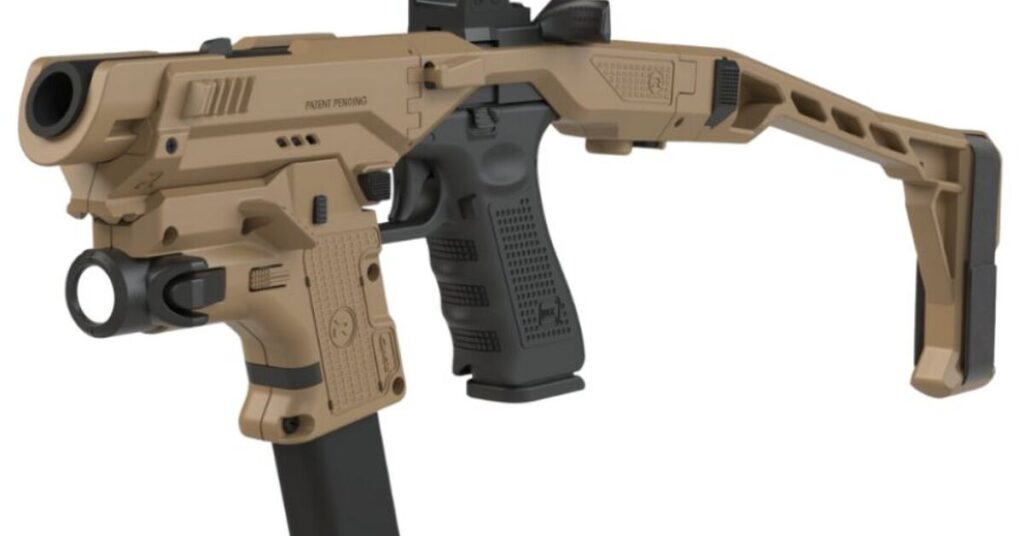
The Nano Roni arrives at a moment when the pistol-to-PDW conversion market is maturing from novelty to necessity, and its two-hundred-dollar price tag signals that the barrier to entry is finally dropping. Where earlier Roni kits leaned toward full-size carbine aesthetics, this micro-platform keeps the overall length short enough to stay maneuverable inside a vehicle or under a jacket while still giving the shooter a third point of contact and a legal brace. That combination matters because it turns a common defensive handgun into something that can actually reach across a room or parking lot without crossing into the NFA’s braced-pistol gray zone that keeps shifting with every ATF letter.
For the 2A community the real story isn’t just the hardware; it’s the message that lawful gun owners keep finding ways to stay inside the rules while still extracting maximum utility from the firearms they already own. At roughly the cost of a decent optic or a training class, the Nano Roni democratizes the PDW concept that used to require an SBR stamp, a dedicated lower, or a trust. That accessibility pushes back against the narrative that modern sporting arms are only for the well-heeled or the well-connected, and it quietly expands the pool of people who can train with a braced platform instead of defaulting to a full-size rifle that may be harder to store or transport in dense urban environments.
Critics will call it another “work-around,” but the deeper implication is that the right to keep and bear arms is being exercised at the level of design innovation rather than litigation alone. Every time a small manufacturer finds a legal configuration that improves control, capacity, and accuracy without creating a new regulated item, it reinforces the principle that the Second Amendment is a practical right, not merely a theoretical one. The Nano Roni won’t replace dedicated rifles, yet it hands everyday carriers another tool that respects both the law and the real-world geometry of self-defense.


