

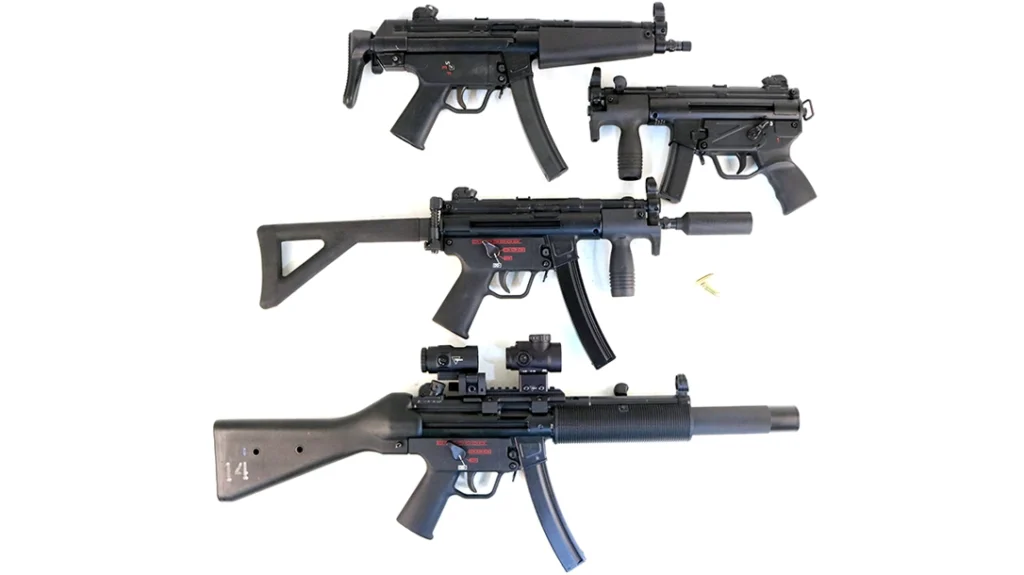
The Heckler & Koch MP5 didn’t just appear in movies—it became the visual shorthand for controlled, professional violence that audiences instantly recognized. From the precise, roller-delayed blowback action that keeps the weapon flat during full-auto bursts to its telescoping stock and modular rail options, the MP5 offered filmmakers a compact package that looked tactical without the unwieldy length of a rifle. Directors quickly learned that an MP5 in the hands of a suited operator or a bank-robber crew signaled competence and immediacy; the gun’s distinctive “clack-clack” of the cocking handle became almost as iconic as the weapon itself. That cinematic ubiquity turned the MP5 into more than hardware—it became cultural shorthand for the idea that a well-designed firearm can project authority and restraint at the same time.
For the 2A community, the MP5’s Hollywood legacy carries a double edge. On one hand, its repeated starring role normalized the notion that civilians and professionals alike benefit from compact, reliable platforms chambered in pistol calibers, reinforcing arguments that such firearms serve legitimate defensive and sporting purposes. On the other, the same footage is routinely trotted out by opponents to paint semi-auto carbines and pistol-caliber weapons as “military-grade,” ignoring that the MP5’s roller-delayed system and 9 mm chambering place it squarely in the same category as countless legal semi-auto pistols and carbines. The result is a feedback loop: every time an MP5 appears on screen, it quietly educates viewers about the mechanical realities of firearms while simultaneously giving anti-2A advocates fresh imagery to exploit. Understanding that dynamic lets supporters counter the narrative with facts about the gun’s civilian-legal variants, its widespread use by law-enforcement agencies, and the constitutional principle that the right to keep and bear arms isn’t diminished by its appearance in entertainment.


