

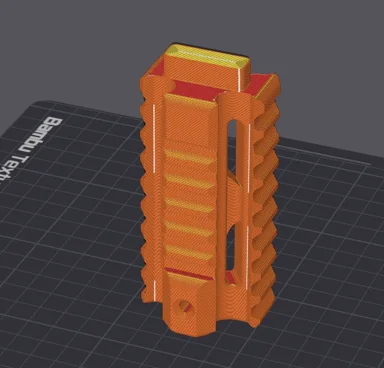
The Model 1 Nylon release quietly marks a turning point in how the 2A community thinks about material science and manufacturing independence. By eliminating external overhangs, the designer has removed the last practical barrier between hobbyists and high-performance polymers like TPU and PPA, letting builders print frames that are both flexible and glass-fiber reinforced without supports or exotic hardware. That single engineering decision collapses the cost curve: what once required an industrial SLS printer or an FFL-mediated transfer can now emerge from a sub-$300 desktop machine in a garage, dramatically widening the pool of people who can exercise their right to keep and bear arms without asking permission from supply chains or regulators.
Equally significant is the decision to release the file openly while monetizing only the finished PPA-GF version. This dual-track approach threads the needle between open-source principles and sustainable entrepreneurship, proving that transparency need not cannibalize sales when the value-add is material quality and post-processing know-how. For the broader community it sets a precedent: creators who share source files invite scrutiny, iteration, and rapid safety improvements, while still capturing revenue from builders who prefer turnkey parts. In an era when regulators eye 3D-printed firearms with increasing suspicion, that transparency may prove more protective than secrecy, because an openly discussed, publicly stress-tested design is harder to paint as an unregulated “ghost gun” and easier to defend as an exercise of constitutionally protected technology.
The deeper implication is cultural. Nylon and PPA frames are no longer exotic one-offs; they are becoming the default substrate for the next generation of 2A innovation. As builders adopt these tougher, lighter, and more temperature-resistant materials, the conversation shifts from “Can it be done?” to “How light, how durable, how modular can we make it?” That reframing strengthens the community’s hand in both the regulatory arena and the marketplace, because the products that emerge will be objectively superior to many legacy offerings. In short, the Model 1 Nylon is less a single printable frame than a proof-of-concept that the right to bear arms is increasingly being secured not by legislation alone, but by open-source chemistry and desktop manufacturing.


